
Section 48E is the technology-neutral clean electricity investment credit that businesses claim for commercial solar in 2026. It offers a 30 percent base credit for projects meeting labor requirements, with bonus adders that can push the total to 50 percent. Here is how it works, what qualifies, and the timelines that matter.
- The 48E credit replaced the old Section 48 ITC for projects placed in service from 2025 onward, and it remains available to businesses in 2026.
- The headline rate is 30 percent for projects that satisfy prevailing wage and apprenticeship requirements; the base rate without them is 6 percent.
- Bonus adders of 10 percentage points each exist for domestic content and energy communities, plus 10 or 20 points for qualifying low-income projects.
- Businesses can pair the credit with five-year MACRS depreciation, which is where much of the total value comes from.
- Tax law here is technical and still evolving. Confirm every detail with a tax professional before committing capital.
What Section 48E Actually Is
Section 48E is the clean electricity investment credit, a technology-neutral federal tax credit for businesses that invest in qualifying zero-emission electricity generation. It took over from the old Section 48 investment tax credit for projects placed in service on or after January 1, 2025. Instead of naming specific technologies, the law credits any facility with zero greenhouse gas emissions, which includes solar, wind, and certain other generation. For a business installing rooftop or ground-mount solar, 48E is simply the credit you claim.
This matters because of a common confusion. The residential credit, Section 25D, ended for systems installed after December 31, 2025. Some business owners heard “the solar tax credit is gone” and stopped there. It is not gone for businesses. The commercial credit survived the 2025 budget reconciliation law in modified form, and solar developers continued to finance projects against it through 2026. Our business ITC mechanics guide covers how companies structure around the credit in practice.
Credit Rates and the Labor Rules
The 48E credit has a two-tier structure. Projects that meet prevailing wage and apprenticeship requirements qualify for the full 30 percent rate. Projects that do not meet those requirements get a base rate of just 6 percent. That 24-point gap is the single most important design feature of the current credit, and it is why commercial proposals in 2026 almost always assume the labor rules are satisfied.
Small projects get a break: facilities under 1 MW (AC) are generally exempt from the wage and apprenticeship requirements and can still claim the 30 percent rate. For larger projects, the installer must pay prevailing wages and employ a qualifying share of apprentice labor, with the required apprentice percentage stepping up over time. Keep documentation. If the IRS ever questions the credit, payroll records proving compliance are the evidence that protects the 30 percent rate. The IRS publishes prevailing wage and apprenticeship guidance that your installer and tax advisor should be working from.
The Bonus Adders That Stack Higher
Three bonus adders can stack on top of the 30 percent base, and they are where well-sited projects reach 40 or 50 percent total credit value. Each adder is worth 10 percentage points, except the low-income adder which can be 10 or 20 points depending on project type.
| Bonus adder | Extra credit | What it requires |
|---|---|---|
| Domestic content | +10 points | Minimum share of US-made steel, iron, and manufactured components |
| Energy community | +10 points | Project in a qualifying area such as a former fossil-fuel community |
| Low-income communities | +10 or +20 points | Facilities under 5 MW AC in qualifying areas or benefiting low-income households; allocated capacity |
The domestic content adder deserves attention in 2026 because trade policy has made US-assembled equipment more available and, in some cases, price-competitive once the extra 10 points are counted. A project that hits both the domestic content and energy community adders reaches a 50 percent credit before depreciation, which transforms project economics. The low-income adder has limited allocated capacity each year and requires an application, so it is the hardest to count on. Map your site against the Department of Energy mapping tools early; adder eligibility should be settled during project design, not discovered at tax time.
What Equipment and Projects Qualify
Qualifying property generally includes the solar equipment itself, panels, inverters, racking, and the electrical equipment up to the point of interconnection, plus energy storage equipment installed alongside or as part of the project. Standalone storage paired with a solar facility can also qualify. What typically does not qualify: the building itself, structural roof upgrades beyond what the solar installation requires, and land costs.
Both new construction and retrofits qualify, and there is no requirement that the business own the building in every structure. In third-party ownership models, the developer that owns the system claims the credit. One nuance worth flagging: used equipment rules and related-party transactions have specific limitations, so buying a secondhand system or selling a project to an affiliated company needs professional structuring. When in doubt, the conservative reading is that new equipment, installed by an unrelated contractor, on a site your business controls, is the clean fact pattern.
Timelines and Phase-Out Rules
For solar, the credit begins to phase down for projects placed in service after the early 2030s under current law, with the phase-out tied to emissions targets and statutory dates that Congress can change. The practical message for 2026 is simpler: projects starting construction now lock in the current 30 percent structure, while waiting introduces legislative risk. The 2025 reconciliation fight showed how quickly credit terms can be rewritten.
Two timing concepts matter. “Commence construction” rules let a project qualify based on when physical work began or when enough costs were incurred, even if completion comes later. “Placed in service” is when the system is actually operating and interconnected. Your tax advisor and developer should agree in writing which milestone each project document references, because incentive applications, utility interconnection, and tax filings all use slightly different clocks.
Pairing the Credit With Depreciation
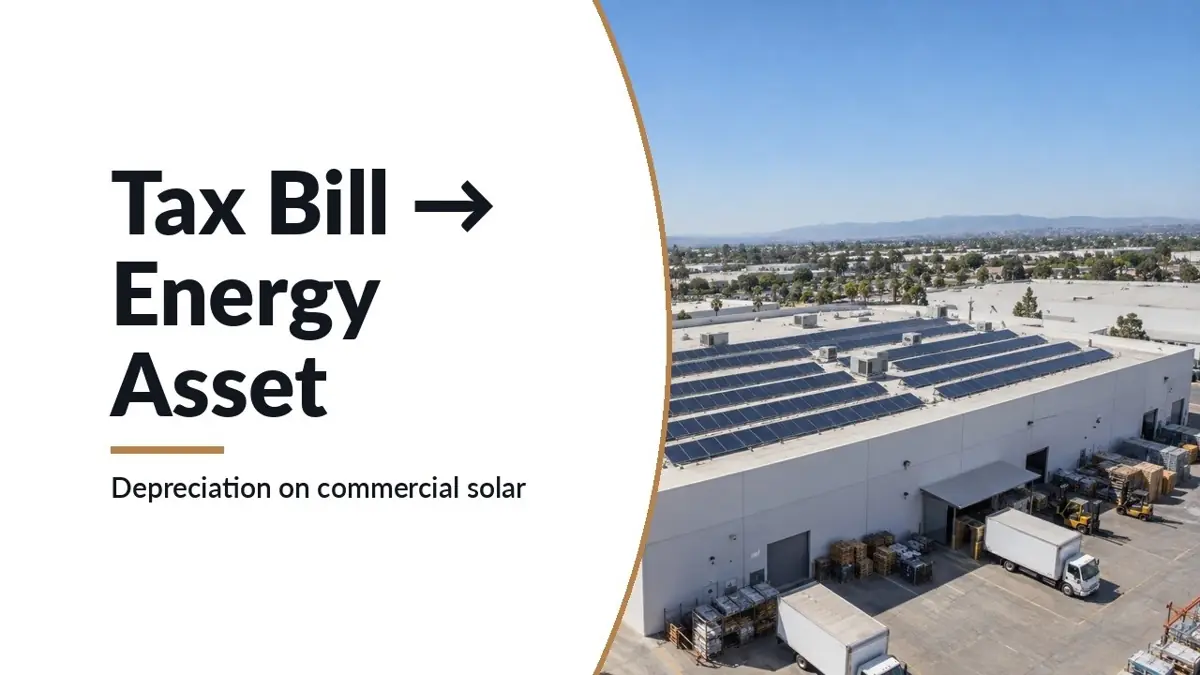
The credit is only half the tax story. Commercial solar equipment is generally five-year property under MACRS, meaning the cost is deducted over six tax years on an accelerated schedule. Historically, bonus depreciation allowed much of that deduction in year one; bonus rules have changed several times and remain subject to legislation, so confirm the current percentage with your tax professional rather than assuming 100 percent.
A modeled example shows the combined power. Take a $500,000 project at the 30 percent credit rate: the credit is worth $150,000. Depreciation on the depreciable basis, worth roughly $75,000 to $105,000 in present value at typical corporate tax rates, stacks on top. Total tax value approaches $225,000 to $255,000, or about half the project cost, before a single kWh of electricity savings is counted. This stacking is why commercial solar economics look so different from residential, and why our commercial financing guide treats tax appetite as the first question in every structure.
How Businesses Actually Claim It
Claiming the credit is a tax filing exercise, not a rebate application. The business files the appropriate IRS energy credit forms with its return for the year the project is placed in service, carrying forward any unused credit to future years within the allowed window. Direct pay, where tax-exempt entities can receive the credit value as a payment, exists for qualifying organizations like municipalities, schools, and nonprofits, which opened commercial-style solar to entities with no tax liability at all.
Businesses with insufficient tax liability have two more routes: transfer the credit to an unrelated buyer for cash, or use a tax-equity partnership where an investor with appetite funds the project in exchange for the credits. Each route has transaction costs that only make sense above certain project sizes, typically in the hundreds of thousands of dollars. Whatever path you take, engage the tax advisor before signing the construction contract, not after. Credit eligibility is easiest to protect when the paperwork is designed around it from day one.
Is the 48E credit the same as the old solar ITC?
Effectively, yes, for new projects. Section 48E replaced Section 48 for projects placed in service from 2025 onward. It is technology-neutral rather than solar-specific, but solar projects claim it the same way businesses used to claim the ITC.
Can I claim 48E if my business has no tax liability this year?
You may be able to carry the credit forward, transfer it to a buyer, or use tax-equity structures. Tax-exempt entities may qualify for direct pay. The right route depends on project size and your financials, so get professional advice.
What happens if my project does not meet the labor requirements?
Projects of 1 MW AC or larger that miss the prevailing wage and apprenticeship rules generally fall to the 6 percent base rate instead of 30 percent. That is a project-killing difference, which is why compliance documentation matters.
Do batteries qualify for the 48E credit?
Energy storage technology, including standalone storage in many cases, can qualify under the current rules. Storage paired with solar is the most common qualifying configuration. Confirm the specifics of your setup with a tax professional.
Where can I verify incentive rules for my state?
State and utility incentives stack with the federal credit. Verify current programs at dsireusa.org, which tracks every state’s offerings, since rules change frequently.
Ready to compare real solar prices?
Get free, no-pressure quotes from vetted local installers and see what solar costs for your roof.