
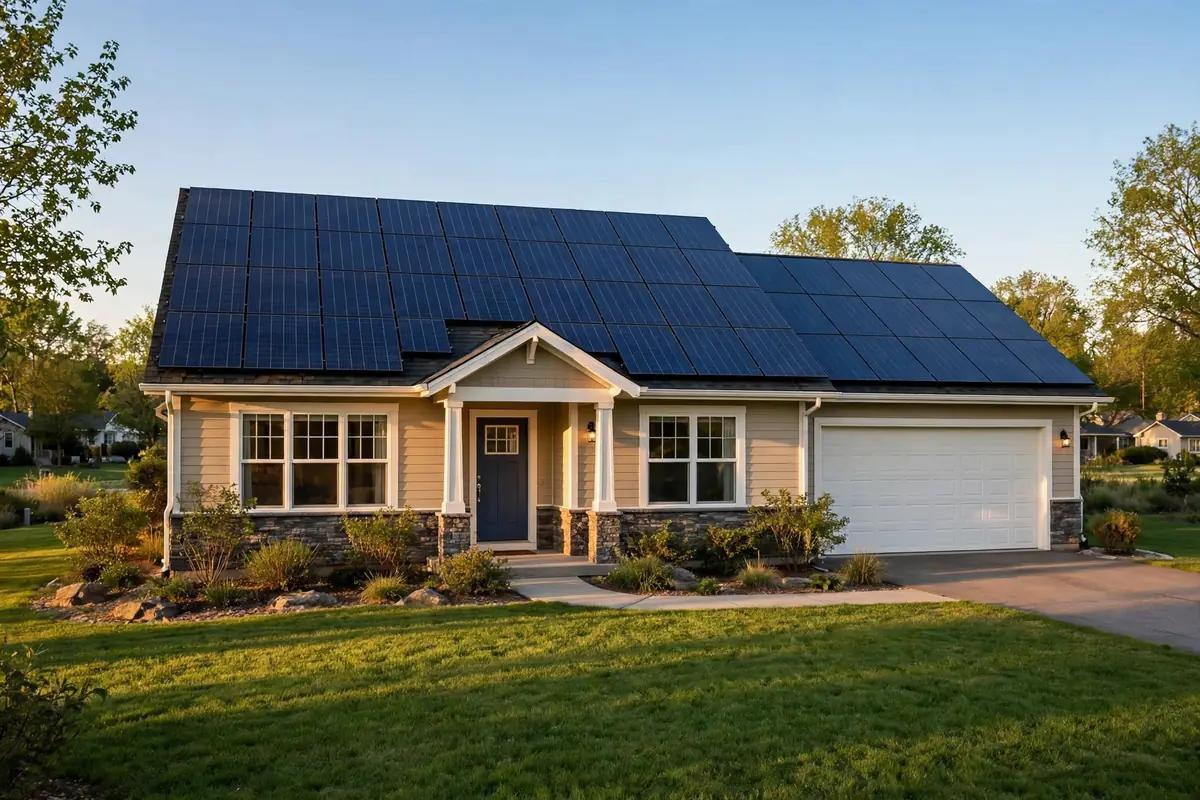
A 1,500 square foot home usually needs a 6 to 8 kW solar system, which costs roughly $15,000 to $28,000 installed in 2026 before any state incentives. But square footage is only a rough proxy for what you will actually pay. Your electric bill, roof layout, and local labor rates move the number more than the size of your house.
- Most 1,500 sq ft homes need 6 to 8 kW of solar, or about 15 to 20 panels.
- Expect $15,000 to $28,000 installed at 2026 cash prices of $2.50 to $3.50 per watt.
- Your monthly kWh usage determines system size far more accurately than square footage.
- Regional prices vary by 30% or more: the same system costs less in Texas than in Massachusetts.
- Financed quotes often run 15 to 30 percent above cash prices because of dealer fees.
Why square footage is a misleading starting point
Installers ask about your square footage because it is an easy question, not because it is a precise one. Two 1,500 sq ft homes can have wildly different electricity needs. A well-insulated home with gas heat and a retired couple might use 500 kWh a month. The same floor plan with electric heat, a pool pump, and teenagers gaming all evening can burn through 1,500 kWh. That is a 3x difference in system size for identical square footage.
The number that actually sizes your system is your annual kWh usage, printed on every electric bill. Add up 12 months, divide by 12, and you have your monthly average. A 1,500 sq ft home in the US averages roughly 800 to 1,000 kWh per month, but your bills are the only figure that matters. If you are unsure how to convert your bill into panels, our guide on sizing a system from your electric bill walks through the math step by step.
The typical system for a 1,500 sq ft home
For a home using 900 kWh per month with decent sun, the math works out to roughly a 7 kW system. Here is why: 900 kWh per month is 10,800 kWh per year. In an average US location producing about 1,400 kWh per installed kW per year, you need 10,800 / 1,400 = 7.7 kW. Round to available panel increments and you land at a 7 to 8 kW system, or 17 to 20 modern 400+ watt panels.
Sunlight changes this. In Phoenix, the same usage needs closer to 6 kW because each panel produces more. In Seattle, it might take 9 kW. Your installer’s production estimate should be based on your specific roof using satellite shading analysis, not a national rule of thumb. If a quote sizes your system without ever asking for your bills or looking at your roof on imagery, that is a red flag, and our guide to reading a solar quote line by line shows what proper sizing documentation looks like.
Full cost breakdown by system size
At 2026 cash prices of $2.50 to $3.50 per watt, here is what the realistic range looks like for homes in this size bracket:
| System size | Panels (approx.) | Monthly usage it covers | Installed cost range |
|---|---|---|---|
| 5 kW | 12 – 13 | ~550 kWh | $12,500 – $17,500 |
| 6 kW | 14 – 15 | ~650 kWh | $15,000 – $21,000 |
| 7 kW | 16 – 18 | ~775 kWh | $17,500 – $24,500 |
| 8 kW | 18 – 20 | ~900 kWh | $20,000 – $28,000 |
| 9 kW | 21 – 23 | ~1,000 kWh | $22,500 – $31,500 |
Where does the money go? Roughly a third is equipment (panels, inverter, racking, wiring), a third is labor and installation, and a third is everything else: permitting, inspections, interconnection, monitoring setup, overhead, and margin. DOE cost benchmarks break this down in detail and confirm that “soft costs” are why American solar costs roughly twice what equivalent systems cost in Australia or Germany.
What actually drives your price
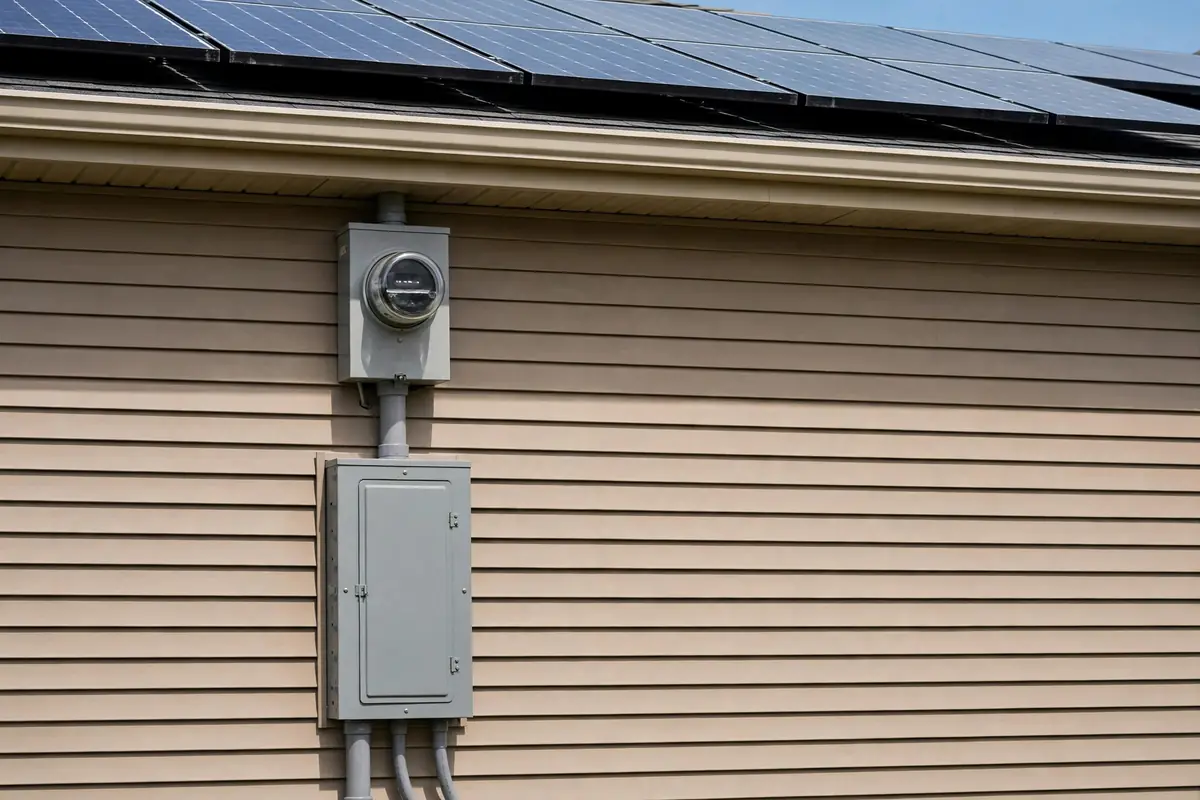
Beyond system size, five factors swing your quote more than most homeowners expect. Roof complexity is the biggest: a simple single-plane asphalt roof is the cheapest install; multiple roof faces, steep pitches, tile, or metal add labor hours and specialized mounting. Electrical work comes next: an older 100-amp panel that needs upgrading to 200 amps can add $1,500 to $3,000. Equipment tier matters too: premium panels and microinverters add 10 to 20 percent over value-tier string inverter systems.
Installer type is the factor people underestimate most. National companies with commissioned sales teams carry far higher customer-acquisition costs than local installers who live on referrals, and that shows up directly in per-watt pricing. This is a major reason quotes vary 40 percent between installers for the same roof. Finally, adders: trenching for ground mounts, critter guards, consumption monitoring, and extended warranties each add a few hundred to a few thousand dollars. Some are worth it; some are margin padding. Ask for each adder to be priced separately.
Regional price differences
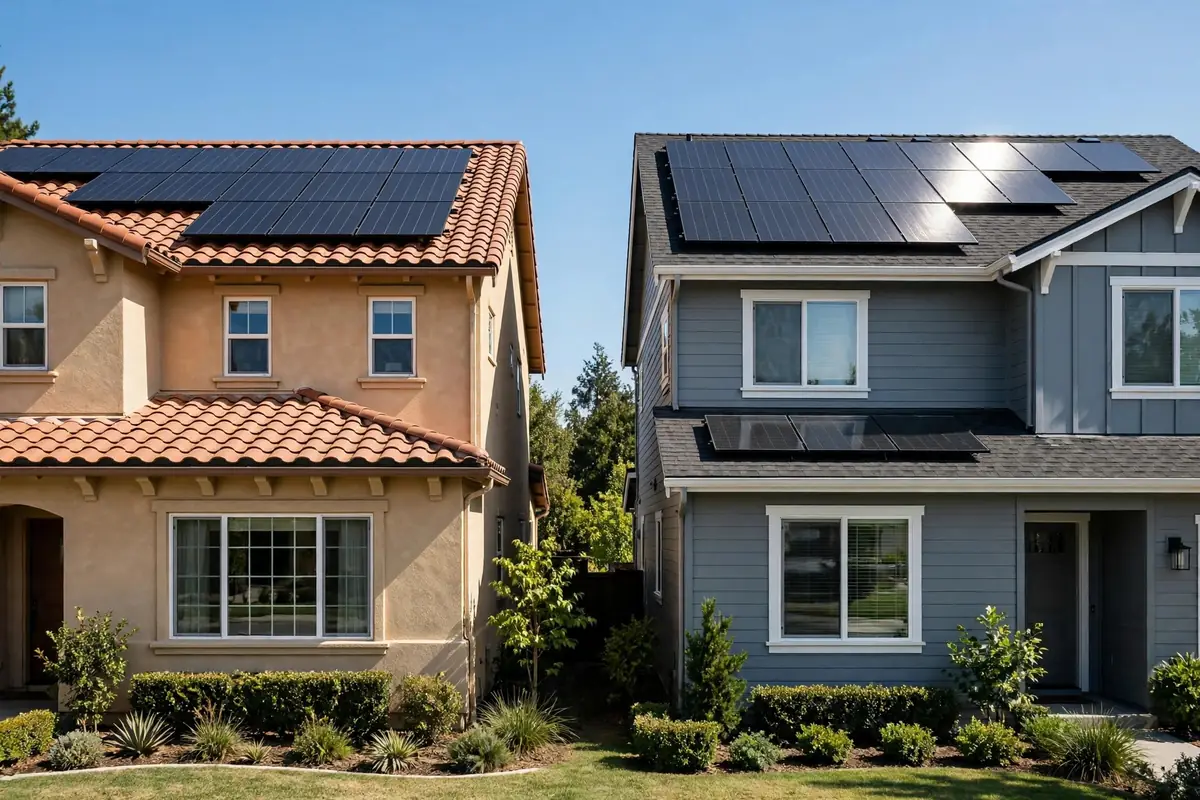
Where you live moves the number substantially. High-cost markets like California, Massachusetts, and New York often quote $3.20 to $3.80 per watt because of labor rates, permitting complexity, and licensing requirements. Lower-cost markets like Texas, Florida, and Arizona frequently land at $2.50 to $3.00 per watt. That means an identical 7 kW system might cost $19,000 in Houston and $25,000 in Boston.
But price per watt is only half the story. Expensive markets often have expensive electricity, which improves payback even at higher install costs. A $25,000 system offsetting 35-cent California power can pay back faster than a $19,000 system offsetting 13-cent Texas power. Always evaluate cost against your local rate, not against a national average. State incentives layer on top: property tax exemptions, state credits, and utility rebates still exist in many states even after the federal credit ended, and DSIRE is the authoritative place to check yours.
Cash vs financed: the hidden gap
This deserves its own section because it surprises nearly everyone. Most solar loans carry dealer fees of 15 to 30 percent, which the lender charges the installer and the installer passes to you in a higher contract price. A system quoted at $22,000 cash might be quoted at $28,000 on a 25-year loan at a low advertised rate. The monthly payment looks attractive; the total cost is not.
That does not make financing automatically bad. If the loan payment is well below your current electric bill and you cannot pay cash, financing still saves money from month one. But always ask for the cash price alongside any financed quote so you can see the true cost of the loan. If an installer refuses to give a cash price, get another installer. And be wary of comparing quotes where one is cash and another is financed: normalize to cash price per watt before judging which is cheaper. Our quote vs reality guide shows exactly how these gaps hide in proposals.
The bottom line for your home
For a 1,500 sq ft home in 2026, budget $15,000 to $28,000 for a cash purchase of a properly sized 6 to 8 kW system, then adjust for your usage, roof, and region. Pull your last 12 electric bills before talking to any installer; the homeowner who knows their kWh gets better sizing and better prices than the one guessing from square footage. Get at least three quotes, compare cash price per watt on identical equipment, and remember that in the post-tax-credit era, the installer you choose matters as much as the panels you choose.
Why costs are reasonable now
- Panel prices near historic lows
- Standard 6-8 kW systems are installers’ bread and butter, so pricing is competitive
- High-watt panels mean fewer panels and less labor than five years ago
Watch out for
- Financed quotes inflated 15-30% by dealer fees
- Roof or electrical upgrades adding thousands
- Quotes sized from square footage instead of your bills
How many solar panels does a 1,500 sq ft home need?
Typically 15 to 20 panels, depending on your electricity usage and panel wattage. At 430 watts per panel, a 7 kW system needs about 17 panels. Your monthly kWh usage is the real sizing input, not the square footage.
Is $3.00 per watt a good price in 2026?
Yes, $3.00 per watt cash is a solid, competitive price in most US markets. Below $2.75 is excellent; above $3.50 deserves scrutiny unless your roof or market is genuinely difficult.
Does a bigger house always need more solar?
No. Electricity usage determines system size, and usage correlates only loosely with square footage. Heating fuel type, appliances, EV charging, and occupant habits matter far more.
How much roof space does a 7 kW system need?
Roughly 350 to 450 square feet of usable, unshaded roof. Modern panels are about 18 square feet each, plus spacing for setbacks and access pathways required by fire codes.
Should I oversize my system for future needs?
Mild oversizing (10 to 20 percent) can make sense if an EV or heat pump is coming. But many utilities cap system size relative to historical usage, so check your utility’s rules before paying for extra capacity you cannot use.
Ready to compare real solar prices?
Get free, no-pressure quotes from vetted local installers and see what solar costs for your roof.