
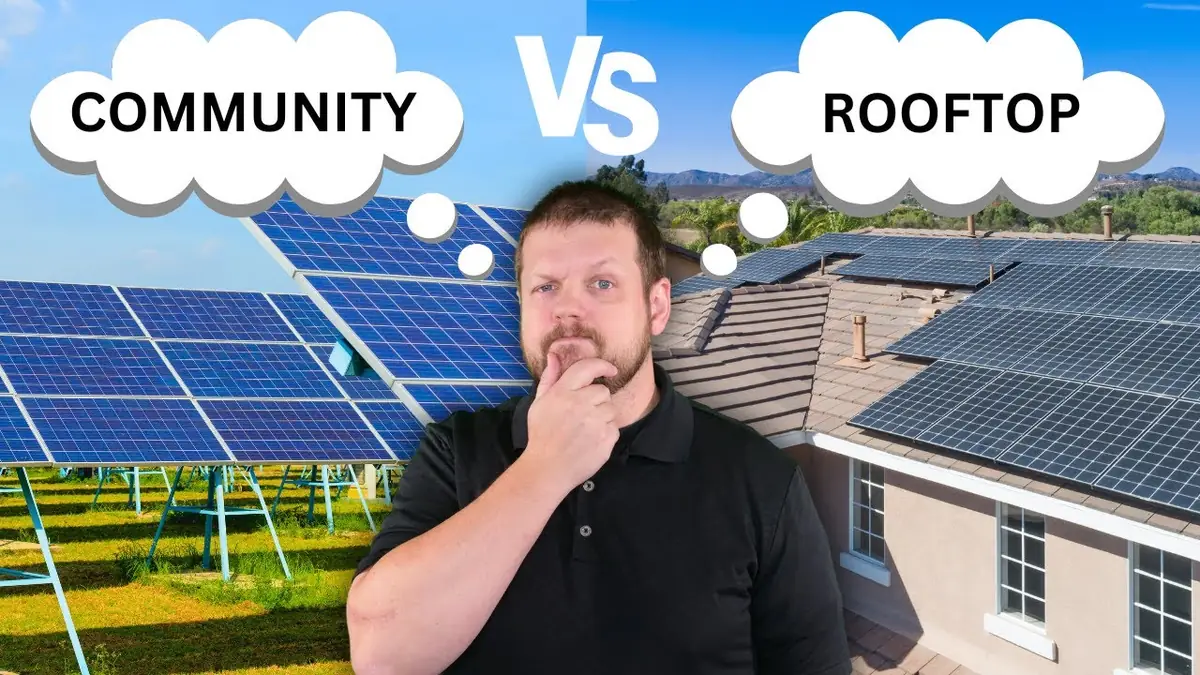
Community solar lets you buy into a shared solar farm with no panels on your roof and no upfront cost, while rooftop solar means owning the system yourself. In 2026, community solar typically shaves 5 to 15 percent off your electric bill, and rooftop solar can offset most of it, but the right choice depends on your roof, your state, and how long you plan to stay put.
- Community solar usually costs $0 upfront and delivers bill credits worth 5 to 15 percent savings, with nothing installed on your property.
- Rooftop solar runs roughly $2.50 to $3.50 per watt in 2026, and a well-sized system can offset 80 to 100 percent of a homeowner’s bill.
- The 30 percent federal credit ended for residential systems installed after December 31, 2025, changing rooftop payback math for 2026 buyers.
- U.S. community solar passed 10.1 GW of cumulative capacity at end-2025; New York and Illinois hosted 68 percent of new installations.
- Renters, shaded roofs, and short-term owners usually win with community solar; long-term owners with good roofs win with rooftop.
How Community Solar Actually Works
Community solar is a shared solar project, usually a ground-mounted array, whose electricity is divided among subscribers. You sign up for a share sized to your usage, the farm feeds the local grid, and your utility applies bill credits for your share. You keep your utility account and meter; nothing gets bolted to your house.
The U.S. Department of Energy defines it plainly: subscribers pay for a share of the electricity a community project generates, typically as a monthly subscription fee, and receive a portion of the dollar value as a credit applied directly to the monthly electric bill. DOE cites research showing nearly 50 percent of households and businesses cannot host rooftop systems, which is exactly who community solar was built for. Details are in the DOE’s community solar basics guide.
Savings come from the spread between the bill credit per kilowatt-hour and the subscription price you pay the operator. If the credit is 14 cents and your subscription costs 12, you pocket 2 cents on every kilowatt-hour your share produces. Most programs advertise 5 to 15 percent off the electricity portion of the bill. Check the subscription rate, yearly escalator, contract length, and cancellation fee before signing.
What Rooftop Solar Costs in 2026
Rooftop solar is the ownership play: you buy the equipment, it sits on your roof for 25 to 30 years, and every kilowatt-hour it makes is one you do not buy. Installed prices in 2026 sit at $2.50 to $3.50 per watt, so a typical 7.6 kW system lands around $19,000 to $26,600 before state or local incentives. Our 2026 worth-it breakdown runs the numbers state by state.
The biggest math change: the federal 25D residential credit ended for systems installed after December 31, 2025. A 2025 install can still claim 30 percent via IRS Form 5695; a 2026 install gets no federal credit for a homeowner purchase. That added roughly $6,000 to $8,000 to the net cost of a typical system and stretched paybacks by years in average-rate states. Leasing companies can still use commercial credits on systems they own, which is why our PPA vs loan comparison looks different in 2026.
What you get is control: 80 to 100 percent of usage offset, decades of rate-hike protection, and generally higher resale value. The catch is needing a suitable roof, roughly $20,000 or financing, and willingness to maintain the system for decades.
Side-by-Side Savings Math
Take a $180 monthly bill ($2,160 a year). Community solar at a 10 percent discount saves about $216 a year, or roughly $5,400 over 25 years, with zero invested. A $23,000 rooftop system offsetting 90 percent of the bill saves about $1,944 a year, or roughly $48,600 over 25 years, leaving the owner ahead by something like $25,000 net. These are labeled examples, not promises; your utility rate is the biggest variable in both.
| Factor | Community Solar | Rooftop Solar |
|---|---|---|
| Upfront cost | $0 in most programs | $15,000 to $30,000 typical |
| Typical annual bill savings | 5 to 15 percent | 60 to 100 percent of usage offset |
| 25-year savings (example) | ~$5,000 to $8,000 | ~$25,000 to $50,000 net of cost |
| Payback concept | Immediate, savings from month one | 8 to 14 years in 2026, no federal credit |
| Who maintains it | The project operator | You (or your installer) |
| Moving | Usually transferable or cancellable | Stays with the house |
| Home value effect | None | Generally positive |
The honest summary: rooftop solar saves several times more money over 25 years, and community solar costs nothing to start. Comparing them on total dollars alone misses the point. The real question is which one fits your housing situation, and that is where most people should start.
Who Should Choose Community Solar
Community solar is the clear answer for renters, since you cannot panel a roof you do not own and subscriptions usually move or cancel when you relocate. It also fits shaded roofs, old roofs due for replacement, condos with HOA restrictions, and anyone unwilling to spend $20,000 on a home they might sell in five years.
Rooftop wins for owners staying 10-plus years with a good south, southwest, or west-facing roof. It wins bigger in high-rate states and for households adding an EV, since charging a Tesla on home solar stretches every panel’s value. With net metering tightening in states like California, owning panels plus a battery gives control no subscription can match.
Pros
- No upfront cost and no installation on your property
- Works for renters, shaded roofs, and condos
- Savings start with the first bill, no payback wait
- No maintenance, monitoring, or repair responsibility
- Easy exit if you move in most programs
Cons
- Savings are modest, typically 5 to 15 percent
- You build no equity and add no home value
- Subscription rates can escalate yearly in some contracts
- Not available in every state or utility territory
- You depend on the operator staying in business
On the “scam” question: community solar is a legitimate, utility-regulated model, but some marketers oversell savings and bury escalator clauses. Treat the subscription like the contract it is. Confirm the discount is guaranteed, read the rate schedule, and check your state’s rules in the DSIRE database before signing.
The 2026 Market in Numbers
Community solar had a paradoxical 2025: installations fell 25 percent to 1,435 MWdc as mature markets cooled, yet cumulative capacity crossed 10.1 GWdc. New York and Illinois installed 624 MWdc and 349 MWdc, 68 percent of national volume, while New Jersey and Maryland set records. Analysts expect about 12 percent growth in 2026. Figures from SEIA’s year-in-review report and pv magazine USA.
Meanwhile SEIA’s Q2 2026 data shows residential installations down 12 percent year over year, exactly what you would expect when the credit disappears. That softness helps shoppers: installers are hungry, and our installer comparison guide shows quotes varying 40 percent or more for identical equipment. Getting three to five quotes matters more than ever.
How to Decide This Month
First, check whether community solar exists in your utility territory and what the guaranteed discount is, using DSIRE and your utility’s website. Second, if you own your home, get rooftop quotes anyway, since a 10 percent community discount is not automatically better than owning. Third, compare 25-year totals, not first-year savings, using realistic bill-reduction estimates.
Fourth, be honest about your timeline: 15 years with a good roof points to rooftop; renting or an upcoming re-roof points to community solar. Fifth, read the subscription like a lease, checking the escalator, term length, transfer rules, and underperformance terms. Those five steps beat 90 percent of solar shopping.
Can I do community solar and rooftop solar at the same time?
Yes. A common setup is a smaller rooftop array plus a community subscription covering the remaining usage. Just size the subscription to your actual leftover bill so you are not paying for credits you cannot use.
Is community solar available in my state?
As of 2026, about 21 states plus Washington, D.C. have enabling policies, but projects physically exist in around 39 states plus D.C. Availability depends on your specific utility, not just your state, so check DSIRE and search your utility’s name plus “community solar.”
What happens to my subscription if I move?
In most programs you can transfer the subscription to your new address if it stays in the same utility territory, or cancel with 30 to 90 days notice. Confirm the exact terms before signing, because a few contracts charge early termination fees.
Does community solar raise my home’s value?
No. Unlike rooftop panels, a subscription is not attached to the property and appraisers do not count it. If resale value matters to you, that is a point for rooftop.
Why is my bill still confusing after joining?
You now track two line items: the subscription charge from the operator and the credit on your utility bill. Smaller winter credits are normal, since the farm produces less. If your bill still feels high after going solar, our troubleshooting guide covers the usual causes.
Ready to compare real solar prices?
Get free, no-pressure quotes from vetted local installers and see what solar costs for your roof.