
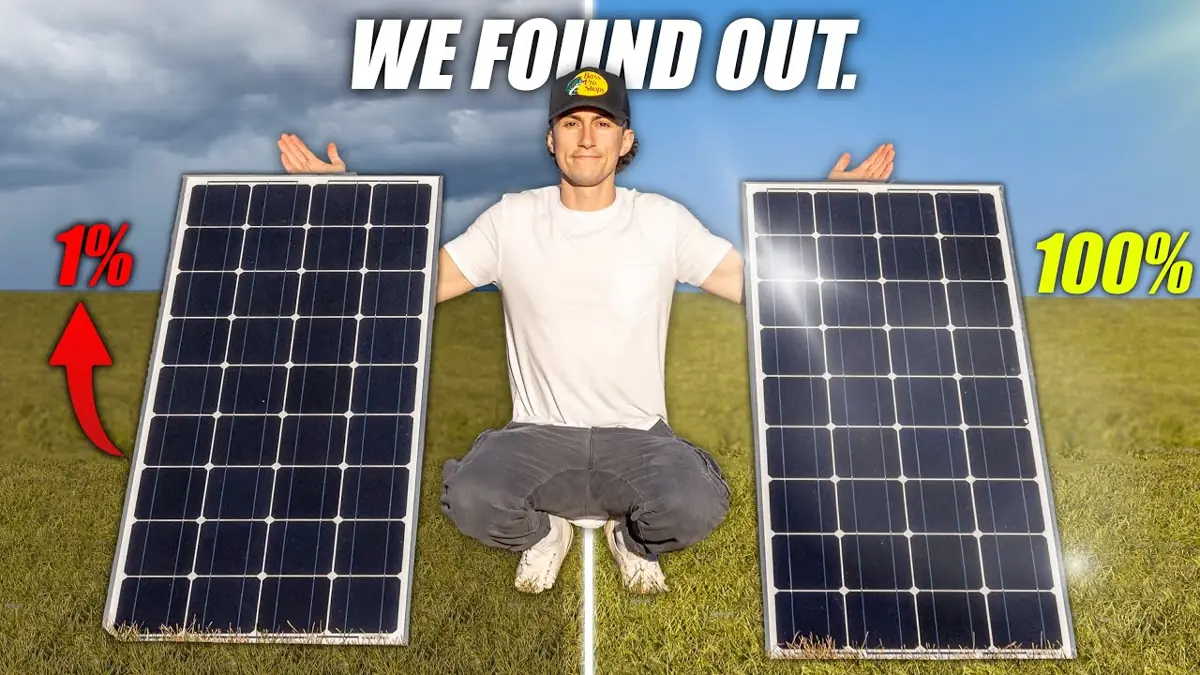
Solar panels do not switch off when clouds roll in. They keep generating from diffuse skylight at a fraction of their sunny output, typically 10 to 25 percent under heavy overcast and 40 to 60 percent under light cloud. Here are the real numbers behind those ranges.
- Heavy overcast: 10 to 25 percent of clear-sky output. Light cloud: 40 to 60 percent.
- Panels harvest diffuse light, so output never drops to zero during daylight, even in rain.
- A single cloudy week barely dents annual production; sunshine distribution matters more than any one day.
- Cooler cloudy-day temperatures slightly raise panel efficiency, offsetting a small part of the loss.
- Monitoring daily output helps you spot real problems versus normal weather variation.
Why Panels Keep Working Without Direct Sun
A solar cell responds to photons, not to sunshine as you perceive it. Direct sunlight delivers about 1,000 watts per square meter to a panel at solar noon on a clear day. Clouds scatter and absorb much of that, but a meaningful share still arrives as diffuse skylight from all directions. The panel converts whatever arrives, which is why production falls but never vanishes while it is light out.
Think of it like a radio: turning down the volume does not switch it off. A panel rated 400 watts in full sun becomes, in effect, a 40 to 100 watt panel under heavy cloud. The inverter keeps running, the meter keeps spinning backward (or forward more slowly), and the day still contributes to your annual total. Homeowners in cloudy climates like Seattle bank on exactly this behavior all winter.
Real Output Numbers by Cloud Type
Not all clouds are equal. Thin cirrus barely dents output, while a dark thunderstorm anvil can drop it below 10 percent. The table below gives typical midday output as a share of clear-sky production for a fixed rooftop array. These are representative field ranges, not lab measurements.
| Sky condition | Typical output vs. clear sky | 400 W panel makes |
|---|---|---|
| Clear blue sky | 100% | ~400 W |
| Thin high cirrus | 80 to 90% | ~320 to 360 W |
| Scattered cumulus | 60 to 80% | ~240 to 320 W |
| Light overcast | 40 to 60% | ~160 to 240 W |
| Heavy gray overcast | 10 to 25% | ~40 to 100 W |
| Dark storm clouds | 5 to 15% | ~20 to 60 W |
Two things surprise most owners. First, partly cloudy days can briefly exceed clear-sky output: when the sun pops between white clouds, panels get direct sun plus extra reflected light from cloud edges, a phenomenon installers call cloud-edge effect. Spikes 10 to 20 percent above rated output are common for a few minutes. Second, morning fog that burns off by 10 a.m. costs far less than it feels like, because the lost hours are the day’s weakest anyway.
The Temperature Twist That Helps
Solar panels hate heat. A typical panel loses about 0.35 to 0.40 percent of its output for every degree Celsius above 25°C cell temperature, and rooftop cells routinely hit 60 to 65°C on hot sunny afternoons. That heat penalty quietly eats 10 to 15 percent of rated output on the sunniest days.
Cloudy days are cooler, so the efficiency penalty shrinks. A panel making 25 percent of its rated irradiance on a cool 15°C day may convert that light a few percent more efficiently than on a scorching afternoon. It does not come close to offsetting the lost sunlight, but it narrows the gap slightly, and it is one reason real-world cloudy-day output often lands at the high end of the published ranges. Panel spec sheets list this as the temperature coefficient, and wattage ratings explained covers how those lab numbers translate to your roof.
What Clouds Do to Annual Production
Single gloomy days feel dramatic and matter little. What counts is the annual distribution of sunshine, which installers model with decades of local weather data. A week of storms in an otherwise sunny climate might cost 1 to 2 percent of annual production. Even in famously gray cities, the year still delivers 60 to 70 percent of desert output per installed watt.
This is also why production guarantees from installers are written annually, not daily. If your contract guarantees a minimum annual output, a cloudy month is not a warranty event; a full year 15 percent below the modeled figure might be. Keep your installer’s production estimate and compare year-end totals, not Tuesday afternoons. Panels also degrade slowly, about 0.5 percent per year, which is a separate and much smaller effect than weather, as degradation data shows.
| Weather pattern | Effect on annual production | Worth worrying about? |
|---|---|---|
| Normal seasonal clouds | Already in the model | No |
| One stormy week | Minus 1 to 2% | No |
| Unusually gray year | Minus 5 to 10% | Only if persistent |
| Wildfire smoke season | Minus 5 to 15% | Yes, in affected regions |
Reading Your Monitoring on Gray Days
Your monitoring app is the best tool for separating weather from malfunction. On an overcast day, expect a low, flat production curve instead of the usual bell shape. That is normal. What is not normal: one panel or string reading near zero while its neighbors produce, a sudden cliff mid-day under steady cloud, or an inverter showing a fault code.
Compare like with like. Most apps show the same date last year or a rolling average; a gray Tuesday should resemble other gray days, not sunny ones. If output looks wrong for the weather, check the inverter display for error codes before calling anyone. Many “dead system” scares turn out to be a tripped breaker or a utility outage. And if you are comparing quotes, our 2026 worth-it guide explains how to sanity-check any installer’s production promises.
It also helps to know your system’s expected cloudy-day baseline. A 8 kW system that makes 40 kWh on a clear spring day should make roughly 8 to 12 kWh under heavy overcast. If your app has a weather overlay or you just glance at the sky, you can do this check in seconds. Persistent underperformance across all weather, not just gray days, is what points to soiling, degradation beyond the expected 0.5 percent annual rate, or equipment faults. Single bad days are weather; bad months are a service call.
Edge Cases: Storms, Smoke, and Eclipses
Wildfire smoke deserves special mention in the western US. Thick smoke can cut production 20 to 40 percent for days, and ash settling on panels adds soiling losses until rain washes it off. It is temporary, but in bad fire years it is a real line item in annual production.
Solar eclipses are the fun edge case: output traces a perfect dip matching the moon’s coverage, then recovers. Hail is the serious one; modern panels are tested with ice-ball impacts, but severe hail can crack cells, which is what homeowner’s insurance is for. None of these change the fundamental picture: panels are weather-hardened equipment, and ordinary clouds are simply part of the production model your system was designed around.
One practical tip for storm season: most grid-tied systems shut down automatically during outages for safety, so a thunderstorm that knocks out grid power also stops your solar until the grid returns, regardless of cloud cover. Only systems with batteries and islanding capability keep running. If storm resilience matters to you, that is a battery conversation, not a panel conversation, and our battery worth-it guide covers whether the backup premium makes sense for your home.
Do solar panels produce anything at night or in the dark?
No. Panels need light, and moonlight is roughly a million times too weak to matter. Nighttime household power comes from the grid or a battery charged during the day.
Should I clean my panels after a cloudy stretch?
Usually not. Rain during cloudy weather washes panels naturally. Cleaning helps mainly after long dry, dusty spells or ash from wildfires, and the production gain is typically 2 to 5 percent.
Will a week of clouds hurt my payback?
Barely. Annual production models already include typical cloudy periods, and one bad week costs roughly 1 to 2 percent of yearly output. Payback math works on years, not weeks.
Do bifacial panels help on cloudy days?
Slightly. Bifacial panels capture light from both faces, and diffuse skylight reaches the rear face better than direct sun does on some mounts. The gain is modest on a standard roof but meaningful on ground mounts over reflective surfaces.
Ready to compare real solar prices?
Get free, no-pressure quotes from vetted local installers and see what solar costs for your roof.