
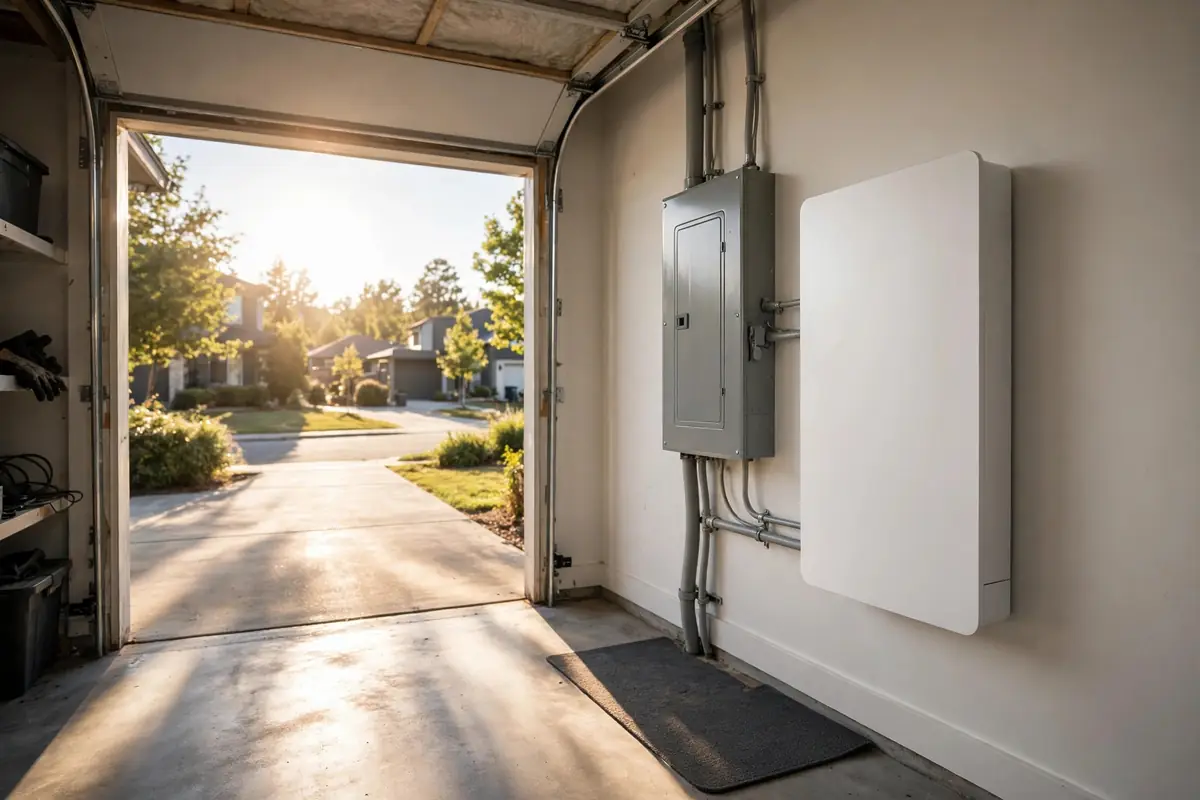
One Tesla Powerwall 3 covers the essentials for most homes through a typical outage, but it cannot do everything. Whether you need a second one comes down to your heaviest loads, how long you want backup to last, and (in California) how you plan to use stored energy every day. Here is how to decide.
- One Powerwall 3 (13.5 kWh, 11.5 kW) runs essential loads for 18 to 24 hours and can start most central air conditioners on its own.
- You likely need two if you have central AC plus other heavy loads, a well pump, an EV you want to charge in outages, or multi-day resilience goals.
- In California under NEM 3.0, a second battery can pay back through daily time-of-use cycling, not just outage protection.
- Adding the second unit later costs $1,000 to $2,000 more than bundling it now, so decide during the initial design if you are on the fence.
The short answer
One Powerwall 3 is enough if your outage plan is “keep the essentials running”: fridge, lights, wifi, phones, and a few comfort loads, for roughly a day without sun. You need two if you want whole-home backup with central air conditioning running freely, if you have heavy loads like a well pump or electric water heater on backup, or if you want genuine multi-day resilience. Most suburban homes with gas heat and no well fall in the one-Powerwall camp; most all-electric homes with AC land in the two-Powerwall camp. For a non-vendor explainer of these trade-offs, see the Department of Energy’s homeowner guide to solar.
The honest mistake is buying two “just in case” without doing the load math, or buying one and discovering your AC cannot run the way you assumed. Both mistakes are avoidable with twenty minutes and your electrical panel. Our Powerwall 3 vs Enphase 5P comparison covers the specs both options are built on.
What one Powerwall can actually do
One Powerwall 3 gives you 13.5 kWh of usable storage and 11.5 kW of continuous power with 30 kW of surge for motor starts. In plain terms: power is rarely the constraint with a single unit. 11.5 kW runs a 3 to 4 ton air conditioner, a refrigerator, and normal household loads simultaneously. The constraint is energy: 13.5 kWh is a finite tank.
On essentials (fridge, lights, wifi, devices, fans: roughly 600 to 700 watts), that tank lasts 18 to 24 hours with no solar help. Add daytime solar recharge and one Powerwall carries essentials indefinitely through multi-day outages in decent weather, because your panels refill the tank each day. This is the scenario most buyers actually experience: the grid drops, the battery takes over in milliseconds, life continues, and the sun tops you back up.
Where one unit shows its limits: running central AC around the clock (a 3-ton unit can burn 25 to 35 kWh per day in summer heat), powering an electric water heater or dryer from the battery, or charging an EV overnight. These are energy-hungry loads that drain 13.5 kWh in hours, not days. If any of them are non-negotiable during outages, keep reading.
When one is enough
You are a strong candidate for a single Powerwall if most of these describe your home:
- Gas or no central AC. Homes with gas heat, mini-splits, or mild climates have modest peak loads. A single unit handles everything easily.
- City water, not a well. Well pumps draw 1 to 2 kW running with a large starting surge, and they cycle unpredictably. Municipal water removes a major backup load.
- Outage history is short. If your utility’s outages are measured in hours, not days, 13.5 kWh plus solar recharge is plenty.
- Your goal is essentials, not normal life. If you are comfortable skipping the dryer and the EV charger during an outage, one unit does the job.
- Budget matters. The second unit costs $9,000 to $12,000 installed. If that money would delay your solar project or strain the budget, one well-sized battery beats two financed at high interest.
A good test: list what you actually ran during your last outage (or what you wished you could run). If the list is fridge, lights, wifi, phones, and a TV, one Powerwall covers it with room to spare.
When you need two
Two Powerwalls (27 kWh, 23 kW continuous) change the experience from “essentials backup” to “whole-home backup.” Consider the second unit if:
- Central AC must run in outages. Technically one Powerwall can start most central ACs, but running it for hours alongside everything else drains 13.5 kWh fast. Two units let the AC cycle normally without constant battery anxiety, especially overnight when there is no solar recharge.
- You have a well pump. The surge from a well pump starting while the AC is running can trip a single battery’s limits. Two units handle overlapping motor starts without drama.
- Multi-day resilience is the goal. In wildfire country, hurricane zones, or areas with fragile grids, 27 kWh plus solar recharge gets a careful household through several cloudy days. See our 3-day outage sizing guide for the full math.
- You want to charge an EV from backup. An EV adds 10 to 30 kWh per charging session. One Powerwall cannot meaningfully charge a car and run a house; two make it plausible for essential driving.
- Your home is all-electric with heavy loads. Electric water heaters (4.5 kW), induction ranges, and pool equipment add up. Two units give you headroom instead of load-shedding Tetris.
| Scenario | One Powerwall 3 | Two Powerwall 3s |
|---|---|---|
| Essentials (fridge, lights, wifi) | 18 to 24 hours | 36 to 48 hours |
| Essentials plus daytime solar recharge | Indefinite in decent sun | Indefinite, more cloudy-day margin |
| Central AC cycling normally | Marginal, drains battery fast | Comfortable |
| Well pump plus household loads | Risky during simultaneous starts | Handles overlapping surges |
| EV charging during outage | Not practical | Possible for essential miles |
The California NEM 3.0 angle
In California, the one-vs-two question is not only about outages. Under NEM 3.0, exported solar earns far less than before, so the winning strategy is storing daytime solar and using it during expensive evening peak hours. A battery that cycles daily for bill savings wears faster but earns its keep differently than a battery sitting in reserve.
Here the second Powerwall can make financial sense even without outage worries: more storage means more of your solar gets used at peak rates instead of exported cheaply. Whether the math works depends on your utility’s time-of-use spread and your evening usage. Homes with high evening consumption (AC, EV charging after work, electric cooking) benefit most. Our Powerwall cost guide breaks down installed pricing to run against your rate plan.
Outside California, most states still have friendlier net metering, which weakens the daily-cycling case for a second battery. In those markets, buy the second unit for resilience, not for bill savings, and size it to your outage plan.
Adding the second one later
You can add a second Powerwall 3 to an existing install, and many owners do. Budget roughly $9,000 to $12,000 for the retrofit: the unit, some additional wiring, and a shorter labor visit. That is $1,000 to $2,000 more than bundling two units in the original install, since you pay for a second truck roll, a second round of commissioning, and sometimes a permit amendment.
If you are genuinely unsure, there is a smart middle path: have your installer design for two now (wall space, conduit, panel capacity, gateway sizing) but install one. The pre-wire costs a few hundred dollars and makes the future addition cheap and fast. Tell the installer this is the plan during the site survey, not after the crew leaves. And whatever you decide, get the full installed cost picture in writing before you sign.
Can two Powerwalls run central AC indefinitely?
During the day with solar recharging, yes in most cases. Overnight, 27 kWh runs a cycling 3-ton AC for roughly 8 to 12 hours depending on heat and thermostat settings. In extreme heat with the AC running constantly, even two units drain overnight.
Do I need a bigger electrical panel for two Powerwalls?
Often yes, or at least a panel evaluation. Two Powerwalls plus your existing loads can exceed a 100-amp panel’s capacity, and even some 200-amp panels need reconfiguration. Your installer should verify this during the site survey.
Is it better to get two Powerwalls or one Powerwall plus a generator?
For short outages, two Powerwalls are silent, automatic, and maintenance-free. For multi-day outages in cloudy weather, a portable generator as backup to a single Powerwall is far cheaper than a second battery. Many rural homeowners choose the hybrid approach.
Will one Powerwall increase my home value less than two?
There is no solid data separating one versus two in resale value. Appraisers and buyers respond to “has battery backup,” not the kWh count. Buy for your needs, not for resale speculation.
Can I mix a Powerwall 3 with an older Powerwall 2?
Tesla supports stacking Powerwall 3 with Powerwall 2 units in many configurations, but mixing generations adds commissioning complexity. If you own a Powerwall 2 and want more storage, get an installer to confirm compatibility with your gateway before assuming it works.
Ready to compare real solar prices?
Get free, no-pressure quotes from vetted local installers and see what solar costs for your roof.