

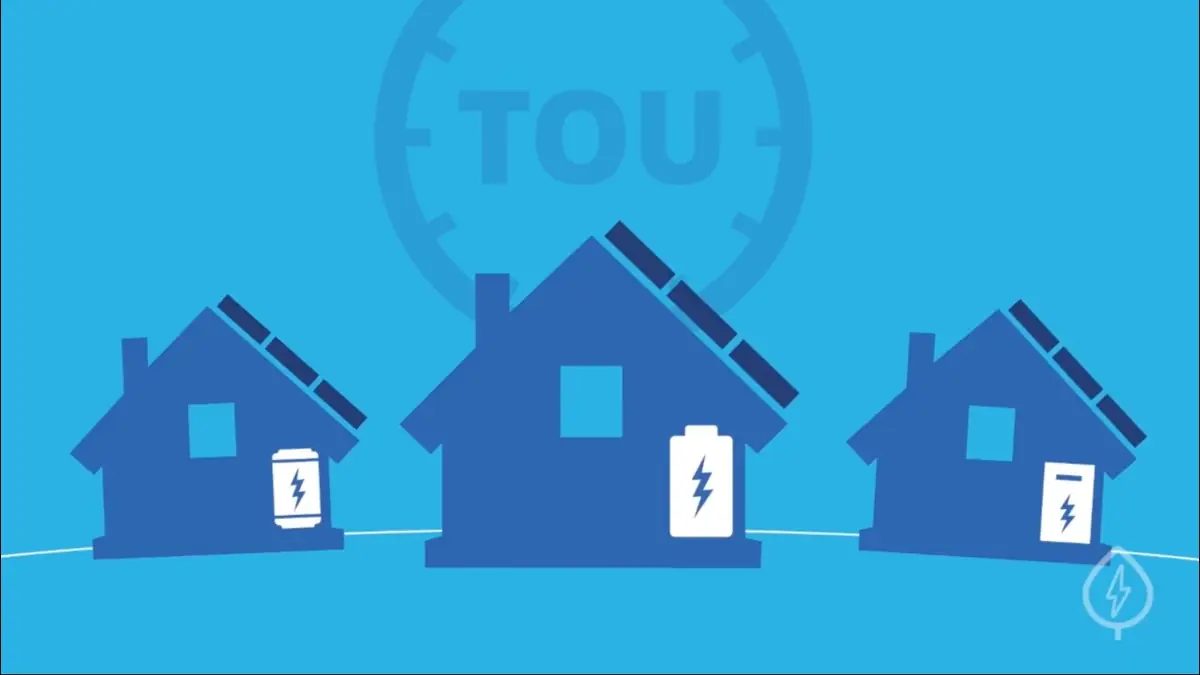
Time-of-use rates turn electricity into two different products: cheap midday power and expensive evening power. Solar panels produce during the cheap window, so pairing them with a battery that carries afternoon surplus into the evening peak is the main way to beat these rates in 2026.
- Time-of-use plans charge 2 to 3 times more per kWh during the evening peak (often 4 to 9 p.m.) than overnight.
- Solar alone offsets mostly cheaper daytime power, which weakens its economics under TOU billing.
- A battery charged from midday surplus and discharged during the peak captures the full rate spread.
- Battery payback under TOU typically takes 8 to 12 years, so the math only works with a wide peak/off-peak spread.
- Without a battery, shifting dishwasher, laundry, and EV charging to midday still trims TOU bills.
How Time-of-Use Rates Work
Under a time-of-use (TOU) plan, your utility charges different prices depending on the hour. The pattern is nearly universal: overnight and midday power is cheap (off-peak), late afternoon and evening power is expensive (peak), and the hours between sit in the middle. In California, the country’s largest TOU laboratory, a typical summer schedule prices off-peak power near $0.30 per kWh and peak power near $0.60 per kWh, with exact numbers varying by utility and season.
Utilities introduced these rates to match the real cost of running the grid. Demand surges when everyone gets home, cooks dinner, and cranks the air conditioning, forcing utilities to fire up their most expensive peaker plants. TOU rates pass that cost signal to you. More than half of US residential customers now face some form of time-varying rate or are being migrated toward one, and the trend is accelerating as utilities modernize metering. Check your own schedule on your bill or at DSIRE, since the peak window and the price spread decide everything that follows.
Why Solar Alone Earns Less Under TOU
Here is the awkward truth: solar panels produce the most power exactly when TOU electricity is cheapest. Your array peaks between 11 a.m. and 3 p.m., squarely inside the off-peak or mid-peak window on most rate schedules. Every kilowatt-hour you self-consume at noon avoids a cheap kilowatt-hour, not an expensive one.
Meanwhile, your heaviest usage still lands in the evening peak. Cooking, lighting, entertainment, and air conditioning all run hardest between 4 and 9 p.m., after your panels have ramped down. Without storage, a solar home under TOU rates typically exports cheap midday surplus and imports expensive evening power. The system still saves money, but noticeably less than the same array would under a flat rate or generous net metering. This is one reason remote workers with daytime loads see better TOU outcomes: their consumption overlaps the production window instead of fighting it.
| Rate period | Typical hours | Example rate | Solar overlap |
|---|---|---|---|
| Off-peak | 12 a.m. to 3 p.m. | $0.30/kWh | Strong (production window) |
| Peak | 4 p.m. to 9 p.m. | $0.60/kWh | Weak (sun setting) |
| Off-peak | 9 p.m. to 12 a.m. | $0.30/kWh | None |
How a Battery Plays the Rate Spread
A battery fixes the timing mismatch. During the middle of the day, instead of exporting surplus at a low credit, the battery stores it. When the peak window opens at 4 p.m., the battery discharges and powers your home through the most expensive hours. This is called arbitrage: buy low (or store your own free midday power), use high.
Most modern batteries automate this. Tesla’s Powerwall, Enphase’s IQ Battery, and FranklinWH’s system all offer a “time-based control” mode where you enter your utility’s rate schedule once and the software handles charging and discharging. You do not need to think about it daily. The battery also keeps its backup reserve separate, so storm protection and bill savings run on the same hardware. If you are comparing units, current Powerwall 3 pricing and whether home batteries are worth it will ground the hardware side of this decision.
The Arbitrage Math: An Example
Consider an example household on the California-style schedule above: $0.30 off-peak, $0.60 peak. A 13.5 kWh battery cycles 10 usable kWh per day through the peak window (keeping a reserve for backup). Each day it avoids buying 10 kWh at $0.60 that would otherwise cost $6.00, instead using solar power that would have exported at a low credit, say $0.05 per kWh, or $0.50 of forgone export value. Net daily gain: about $5.50.
Over a year, $5.50 × 365 = roughly $2,000. Against a battery installed cost of $12,000, that is a 6-year simple payback, which looks attractive. But treat this as an optimistic example: it assumes a full deep cycle every single day, a wide $0.30 rate spread, and low export credits. In states with a narrower spread, say $0.12 off-peak versus $0.22 peak, the same battery earns under $400 a year and payback stretches past 20 years. The spread is everything. Always model your actual utility schedule, not a national average.
| Scenario | Rate spread | Annual battery value | Simple payback on $12,000 |
|---|---|---|---|
| Wide spread (CA-style) | $0.30/kWh | ~$2,000 | ~6 years |
| Moderate spread | $0.15/kWh | ~$900 | ~13 years |
| Narrow spread | $0.08/kWh | ~$400 | ~30 years |
When the Battery Actually Pays for Itself
Three conditions make the battery math work. First, a wide peak/off-peak spread, ideally $0.20 per kWh or more. Second, weak export credits, so storing surplus beats selling it. California’s NEM 3.0, which slashed export compensation, is the textbook case: it simultaneously made solar-alone less attractive and batteries far more valuable. Third, enough surplus to charge the battery: an undersized array cannot fill a 13.5 kWh battery and run the house, so the battery sits half-empty and the payback math collapses.
Pros
- Captures the full peak/off-peak price spread automatically.
- Same hardware provides backup power during outages.
- Reduces dependence on unfavorable export credit rules.
Cons
- High upfront cost: $9,000 to $16,000 installed for ~13.5 kWh.
- Payback fails with a narrow rate spread or small solar array.
- Battery degrades over time; warrantied for about 10 years or a set throughput.
One more nuance: the federal 25D residential credit ended for systems installed after December 31, 2025, which removes a subsidy that used to shorten battery payback considerably. A battery installed in 2026 must earn its keep on bill savings alone. That does not kill the economics where spreads are wide, but it raises the bar. Confirm current incentives at DSIRE and with a tax professional.
Cutting TOU Bills Without a Battery
No battery? You can still blunt TOU rates with timing. Shift the dishwasher, washing machine, and dryer into the midday window when your panels are producing. If you drive an EV, schedule charging for midday on weekends or overnight off-peak, never during the 4 to 9 p.m. peak. A smart thermostat that pre-cools the house at 3 p.m. coasts through the peak on stored cool air.
These shifts are free and surprisingly effective: moving 5 kWh a day out of a $0.60 peak into solar hours saves about $3 a day, or over $1,000 a year. That alone can rival a battery’s arbitrage value in moderate-spread states, at zero equipment cost. For the broader savings picture, see how much solar saves typical households, and if your utility just moved you onto TOU billing, treat it as a prompt to finally put your biggest loads on a timer.
Should I switch to a time-of-use rate if I have solar?
It depends on your utility’s specific plans. Some TOU plans pair well with solar plus a battery; others punish solar-only homes. Compare your last 12 months of usage against each available rate schedule before switching, and verify the peak window hours.
Can a battery charge from the grid overnight instead of solar?
Technically yes on most systems, but charging from cheap overnight grid power to use during the peak is less valuable than using your own solar, and some utilities and incentive programs restrict or penalize grid charging. Solar charging is the cleaner and usually more profitable strategy.
How big a battery do I need for peak shaving?
Size it to your peak-window usage, not your whole home. If you use 8 to 12 kWh between 4 and 9 p.m., a single 13.5 kWh unit (about 10 to 11 usable kWh after reserves) covers it. Oversizing beyond your evening load earns nothing extra.
Do TOU rates change often?
Yes, utilities revise rate schedules every few years through regulatory proceedings, and peak windows have been shifting later as solar floods the midday grid. Model conservatively and recheck your plan annually.
Ready to compare real solar prices?
Get free, no-pressure quotes from vetted local installers and see what solar costs for your roof.