
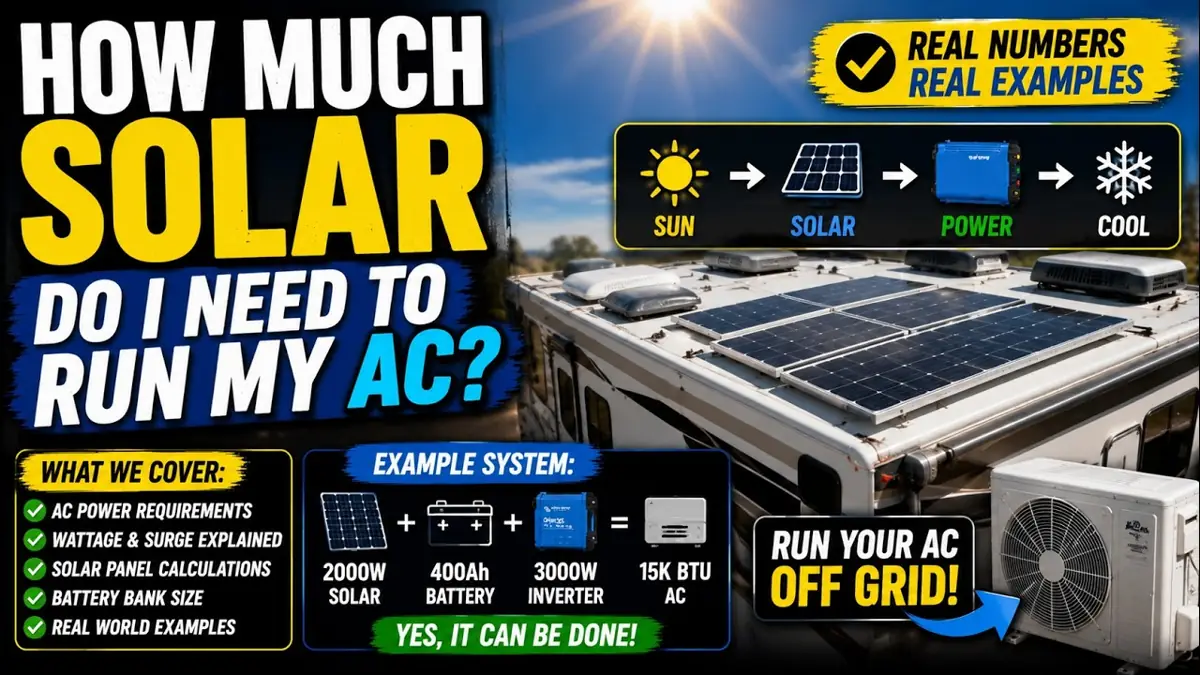
An RV air conditioner is the hardest load to run on solar. This guide gives the real numbers: running watts, the startup surge that kills inverter plans, what one hour of cooling costs in battery, and the panel and battery sizes that make daytime AC workable.
- A 13.5k BTU rooftop AC draws 1,200 to 1,500 W while running and surges to 2,500 to 3,500 W at compressor startup.
- One hour of AC costs about 1.5 kWh from the battery bank after inverter losses; a single 100Ah lithium battery runs it for under an hour.
- A soft start kit cuts startup surge by about 70%, which is what lets a 2,000 W inverter start a rooftop unit.
- Plan on 1,500 to 2,000 W of panels and 5 kWh or more of lithium storage for reliable afternoon cooling.
- A 9k BTU mini-split uses roughly half the power of a rooftop unit and is often the smarter path to solar cooling.
What a 13.5k BTU RV AC Really Draws
Most RV rooftop units are 13.5k or 15k BTU from Dometic or Coleman-Mach. A 13.5k unit draws 1,200 to 1,500 W running; a 15k draws 1,500 to 1,800 W. Fan-only mode drops to about 300 W, which is why some campers run the fan on solar and save the compressor for shore power.
| AC type | Typical running watts | Typical startup surge |
|---|---|---|
| 13.5k BTU rooftop (Dometic / Coleman) | 1,200 to 1,500 W | 2,500 to 3,500 W |
| 15k BTU rooftop | 1,500 to 1,800 W | 3,000 to 4,000 W |
| 9k BTU mini-split | 700 to 1,000 W | Low (inverter-driven ramp) |
| Portable 10k BTU unit | 900 to 1,200 W | 1,800 to 2,500 W |
Those are typical ranges. An aging unit with dirty coils draws more, and extreme heat pushes every number up. Measure your own unit with a clamp meter before sizing anything. For the full power budget, see our RV solar sizing guide for boondocking.
The Startup Surge That Trips Inverters
Running watts are half the story. At startup the compressor draws a locked-rotor surge of 2,500 to 3,500 W for a fraction of a second. That spike trips a 2,000 W inverter, stalls small generators, and dims every light. An inverter sized for running watts alone shuts down every time the compressor cycles.
The fix is a soft start kit, a small controller that ramps the compressor up gradually. SoftStartRV reports its units cut starting inrush current by about 70 percent (see their effectiveness breakdown), so a 13.5k unit that surged to 3,000 W now spikes to roughly 1,000 W, which a quality 2,000 W pure sine wave inverter handles easily. MicroAir’s EasyStart is the other established brand. Budget $250 to $350 and confirm compatibility with your AC model before ordering.
How Much Battery One Hour of AC Costs
A 13.5k BTU unit drawing 1,350 W through a 90 percent efficient inverter pulls about 1,500 Wh from the battery bank per hour. A single 100Ah 12V lithium battery holds 1.28 kWh, so it runs the AC for roughly 50 minutes. Nothing else in the rig eats batteries at this rate.
| Battery bank (usable) | AC runtime (13.5k BTU) | What that means |
|---|---|---|
| 1.28 kWh (one 100Ah lithium) | ~50 minutes | Cools the rig down once, then done |
| 2.56 kWh (two 100Ah lithium) | ~1.7 hours | A lunch break of cooling |
| 5.12 kWh (four 100Ah lithium) | ~3.4 hours | An afternoon of cooling |
| 10.24 kWh (eight 100Ah lithium) | ~6.8 hours | Afternoon plus evening |
These runtimes assume continuous compressor operation, which is reality on a hot day. At 50 percent duty on a mild evening, double them. Lithium is effectively mandatory: full usable capacity, steady voltage under load, fast recharge. See our lithium vs AGM breakdown and 13.5 kWh battery runtime guide.
How Much Solar You Need for Daytime AC
Panels must replace the AC’s energy the same day or the system dies by day two. While the AC runs, the array feeds the 1,350 W load directly and still needs surplus to recharge the bank. Practical rule: install 1.5 to 2 times the AC’s running watts in panels, so 2,000 to 3,000 W for a 13.5k BTU unit.
A 2,000 W array in 5 peak sun hours produces about 8 kWh per day (2,000 x 5 x 0.8). Four hours of afternoon AC consumes about 6 kWh, leaving 2 kWh for everything else. The math closes on a clear desert day and fails on a cloudy one, which is why solar AC is a fair-weather strategy. Our boondocking sizing guide covers the complete workflow.
Three Setups That Actually Run RV AC
Three configurations that real boondockers run successfully, each assuming a 13.5k BTU rooftop unit unless noted.
Afternoon cooling on a big lithium bank. The most common working setup: 800 to 1,200 W of roof solar, 5 to 10 kWh of lithium (four to eight 100Ah batteries, such as Battle Born’s 100Ah 12V LiFePO4), a 3,000 W pure sine wave inverter, and a soft start kit. Run the AC three to five afternoon hours while panels carry most of the load. DIY cost: roughly $6,000 to $9,000.
Mini-split instead of rooftop. A 9k BTU mini-split draws 700 to 1,000 W with almost no startup surge, since its inverter-driven compressor ramps smoothly. That halves battery and panel needs: 600 to 800 W of solar and 3 to 5 kWh of storage match the rooftop’s cooling hours. The catch is mounting an indoor head and outdoor condenser on a moving vehicle. For full-timers parked long-term in heat, it is the most efficient option.
Portable power station for occasional use. An EcoFlow Delta Pro (3.6 kWh) with 400 to 800 W of portable panels runs a soft-started 13.5k BTU unit for about two hours, covering the worst of the afternoon. No roof work, and the station doubles as home backup. Our home battery sizing guide for outages covers the dual-use case. Downsides: cost per kWh and deploying ground panels at every stop.
When Solar AC Is the Wrong Call
Pros
- Silent cooling with no generator noise, fuel, or fumes at camp
- Free afternoon cooling once the system is paid for
- Big battery bank also powers everything else with huge margin
- No campground hookup needed in peak summer season
Cons
- $6,000 to $10,000 system cost for a few hours of daily cooling
- Needs 1,500 to 3,000 W of roof space many rigs do not have
- Fails on cloudy stretches; a week of overcast means no AC
- Heavy battery bank adds hundreds of pounds to the rig
Be honest about your travel style. If you chase mild weather, you may never need AC: park in shade, run vent fans, and put the $6,000 toward fuel. If you must summer in Arizona or Texas, a small inverter generator as hybrid backup beats doubling the array for the worst week of the year. Solar AC suits shoulder seasons and heat waves, not Phoenix in July.
Related Guides
- How to size an RV solar system for full-time boondocking, the complete power-budget workflow
- Lithium vs AGM batteries for RVs, and why AC demands lithium
- How long a 13.5 kWh battery actually lasts running real loads
- Sizing a home battery for power outages, including portable power stations
Can a 2,000 W inverter run a 13.5k BTU RV air conditioner?
Only with a soft start kit. Without one, the 2,500 to 3,500 W startup surge trips the inverter at every compressor kick. With surge cut about 70 percent, a quality 2,000 W pure sine wave inverter handles it reliably.
How many solar panels does it take to run RV AC?
For daytime cooling of a 13.5k BTU unit, plan on 1,500 to 3,000 W of panels. Fewer panels work for an hour or two of runtime if a large battery bank covers the gap, but the bank must recharge the next day.
How long will a 200Ah lithium battery run an RV AC?
About 1.7 hours continuous. Two 100Ah 12V lithium batteries hold 2.56 kWh usable against roughly 1.5 kWh per hour of AC draw. At half duty on a mild night, expect roughly double.
Is a soft start kit worth it for solar?
Yes. It lets you use a 2,000 W inverter instead of 3,000 W, stops nuisance trips, and eases compressor stress. Budget $250 to $350 and confirm fitment with your AC model.
Can I run the AC all night on solar and batteries?
Only with a very large bank: eight continuous hours needs about 12 kWh usable, roughly ten 100Ah lithium batteries. Most boondockers pre-cool in the evening, switch to vent fans overnight, and refill the bank in the morning.
Ready to compare real solar prices?
Get free, no-pressure quotes from vetted local installers and see what solar costs for your roof.