
The battery bank is the heart of any RV solar setup, and the choice comes down to two chemistries: tried-and-true AGM lead-acid and lithium iron phosphate (LiFePO4). Lithium costs two to four times more per battery but stores roughly twice the usable energy, weighs about half as much, and lasts four to six times longer. This guide compares weight, usable capacity, lifespan, and true lifetime cost so you can pick the right chemistry for how you camp.
- A 100Ah AGM battery weighs 65 to 70 lbs and delivers about 50Ah of usable capacity; a 100Ah LiFePO4 weighs 25 to 31 lbs and delivers nearly the full 100Ah.
- AGM batteries last 500 to 800 cycles at 50% depth of discharge; LiFePO4 lasts 3,000 to 5,000 cycles at 80 to 100% depth of discharge.
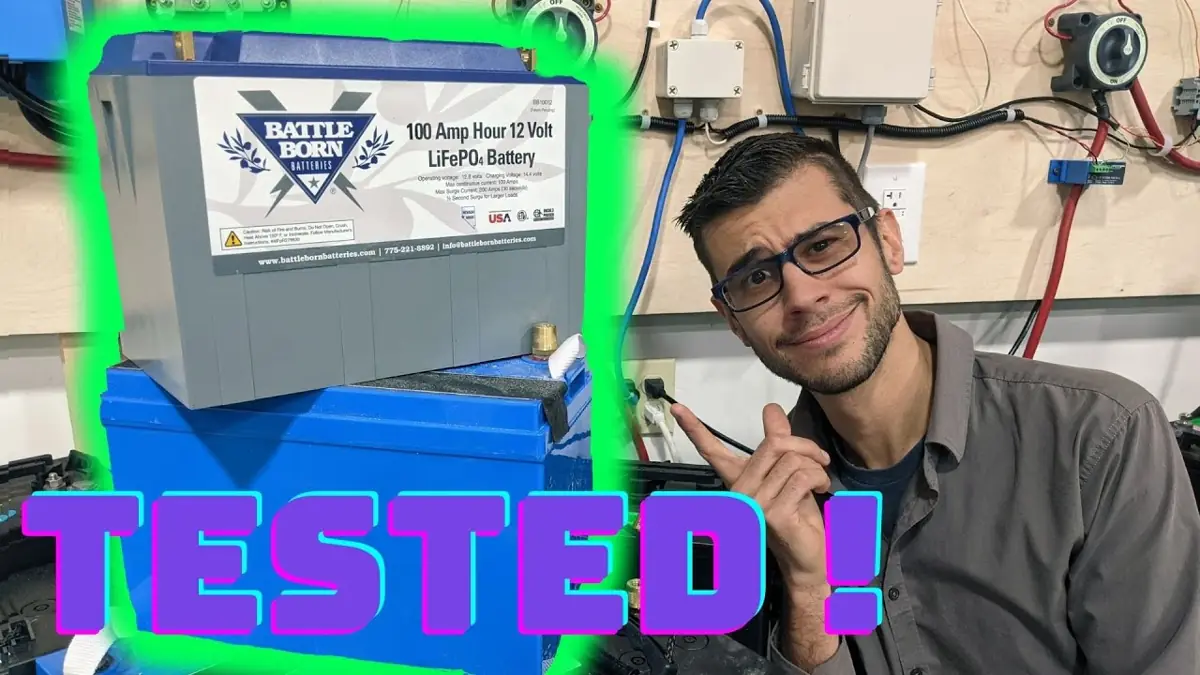
- Budget lithium (LiTime, Redodo) costs $250 to $350 per 100Ah; premium lithium (Battle Born) costs $800 to $950; AGM costs $200 to $300.
- Lithium charges faster and holds voltage under load, but it cannot charge below freezing unless it is a heated model; AGM tolerates cold charging with reduced capacity.
- Over its full life, lithium usually costs less per usable kilowatt-hour despite the higher sticker price.
Usable Capacity: The Number That Matters Most
Ignore the amp-hour rating on the label for a moment. What matters is how many of those amp-hours you can actually use. An AGM battery should only be discharged to about 50% if you want it to live a reasonable life, so a 100Ah AGM gives you roughly 50Ah of usable capacity, or about 600 watt-hours at 12 volts. Drain it to 20% regularly and you will be replacing it far sooner than the spec sheet suggests.
A 100Ah LiFePO4 battery can be discharged to nearly 100% without meaningful damage, thanks to its built-in battery management system. That is about 1,280 watt-hours of usable energy from a battery with the same nominal rating. One lithium battery replaces two AGMs in practical terms. When you are sizing an RV solar system for boondocking, this is the conversion that keeps your battery compartment small and your budget honest.
Weight and Space: Lithium Wins by a Lot
A typical 100Ah AGM deep-cycle battery weighs 65 to 70 lbs. Four of them, a common bank for serious boondockers, add 260 to 280 lbs to the rig, usually hung off the tongue or stuffed into a front compartment. A 100Ah LiFePO4 battery weighs 25 to 31 lbs depending on brand: Battle Born’s 100Ah 12V lists at 31 lbs on battlebornbatteries.com, while budget LiTime units come in around 24 to 26 lbs.
The usable-energy math makes the gap even wider. To get 200Ah of usable capacity you need four 100Ah AGMs (about 270 lbs and a lot of floor space) or two 100Ah lithium batteries (about 55 lbs in half the footprint). For smaller trailers and vans with tight payload ratings, that weight savings alone can settle the debate. It also matters for tongue weight and handling on towables.
Lifespan and Cycle Life Compared
AGM batteries are rated for roughly 500 to 800 cycles at 50% depth of discharge. In real RV use, with partial charging and summer heat, most owners get three to five years from a set. Heat is the quiet killer: every sustained 15 degrees above 77°F roughly halves lead-acid life, and battery compartments in the Southwest get hot.
LiFePO4 batteries are rated for 3,000 to 5,000 cycles at 80 to 100% depth of discharge, which translates to roughly 8 to 12 years of full-time use. Calendar aging eventually catches up, but even conservative estimates put lithium at twice the service life of AGM, and optimistic ones at three times. This is why the cost breakdown of a complete RV solar setup looks so different once you price batteries per year of service instead of per battery.
True Cost Over the Battery’s Life
Sticker price favors AGM. Lifetime cost usually favors lithium. Here is an example calculation for a 100Ah battery, using typical 2026 prices and rated cycle life. Your numbers will vary, but the shape of the result holds across brands.
| Spec | AGM 100Ah | LiFePO4 100Ah (budget) | LiFePO4 100Ah (premium) |
|---|---|---|---|
| Typical price | $200 – $300 | $250 – $350 | $800 – $950 |
| Weight | 65 – 70 lbs | 24 – 26 lbs | 31 lbs |
| Usable energy | ~600 Wh | ~1,280 Wh | ~1,280 Wh |
| Rated cycles | 500 – 800 | 3,000 – 4,000 | 3,000 – 5,000 |
| Example cost per usable kWh over life | ~$0.55 – $0.85 | ~$0.06 – $0.10 | ~$0.18 – $0.28 |
| Charge efficiency | ~85% | ~99% | ~99% |
The per-kWh row is an example, computed as purchase price divided by usable energy times rated cycles. It leaves out replacement labor and the extra solar needed to overcome AGM’s lower charge efficiency, both of which widen lithium’s lead. Budget lithium wins on pure economics. Premium lithium wins if you value the longer warranty and US-based support. For background on the chemistry itself, see our LFP vs NMC battery comparison.
Charging Speed and Cold Weather Behavior
Lithium accepts charge at full rate almost until it is full, while AGM spends a long absorption stage trickling in the last 20%. On a short winter solar day, that difference is real: lithium can grab every available amp, while AGM may never finish charging. Lithium’s ~99% charge efficiency versus AGM’s ~85% also means you need less solar to refill the same usable energy.
Cold weather is lithium’s one genuine weakness. Charging a LiFePO4 battery below 32°F (0°C) plates lithium metal onto the anode and permanently damages capacity. Quality batteries include low-temperature charge protection in the BMS that simply refuses charge when cold. If you camp in freezing weather, buy heated lithium batteries (Battle Born and several budget brands offer them) or keep the bank in a heated compartment. AGM can charge below freezing, though with reduced capacity. For outage-scale storage thinking, our home battery sizing guide covers the same cold-weather trade-offs at house scale.
Which Battery Should You Buy?
Pros
- Lithium: double the usable energy per battery, half the weight, 4 to 6 times the cycle life, faster charging
- AGM: lower upfront cost, no cold-charging damage risk, drop-in replacement for existing lead-acid setups
Cons
- Lithium: 2 to 4 times the upfront cost, needs a lithium charge profile, cannot charge below freezing without heated models
- AGM: only 50% usable capacity, heavy, shorter life, slower charging wastes solar hours
Buy lithium if you boondock regularly, run a compressor fridge, or plan to keep the rig more than three years. Buy budget lithium (LiTime, Redodo) if upfront cost is the constraint; buy premium (Battle Born) if you want the 10-year warranty and phone support. Buy AGM if you camp a few weekends a year with hookups mostly, or you are selling the rig soon and just need working house batteries. Either way, pair the bank with a proper battery monitor so you actually know your state of charge; guessing is how banks die young. Our explainer on how long a 13.5 kWh battery lasts shows the same capacity math applied to whole-home batteries.
Can I mix AGM and lithium batteries in one bank?
No. The two chemistries need different charge voltages and profiles, and paralleling them leads to chronic undercharging of one or overcharging of the other. If you are upgrading, replace the whole bank at once and set your charge controller and inverter-charger to the lithium profile.
Do lithium batteries need a special charger?
They need a charger with a lithium (LiFePO4) charge profile, which nearly every modern MPPT controller and inverter-charger includes as a preset. Older single-stage converters designed for lead-acid should be replaced or supplemented, since they will not fully charge lithium and can confuse its BMS.
Are lithium batteries safe inside an RV?
LiFePO4 is the most thermally stable lithium chemistry in common use and does not have the thermal-runaway profile of phone or EV batteries. Every reputable RV lithium battery includes a BMS that guards against overcharge, over-discharge, short circuits, and temperature extremes. Buy from established brands and fuse the bank properly.
Will my alternator charge lithium house batteries?
Not directly, and you should not try. Lithium’s low internal resistance can pull more current than the alternator is rated for, overheating it. Install a DC-DC charger between the alternator and the house bank; Victron’s Orion line and Renogy units run $100 to $300. It also gives lithium the correct charge profile while you drive.
How many batteries do I need for a weekend of boondocking?
It depends on your loads, not on the calendar. A weekend running lights, phones, a vent fan, and a compressor fridge typically needs 150 to 250Ah of lithium or double that in AGM. Run the load math in our RV solar sizing guide before buying.
Ready to compare real solar prices?
Get free, no-pressure quotes from vetted local installers and see what solar costs for your roof.