
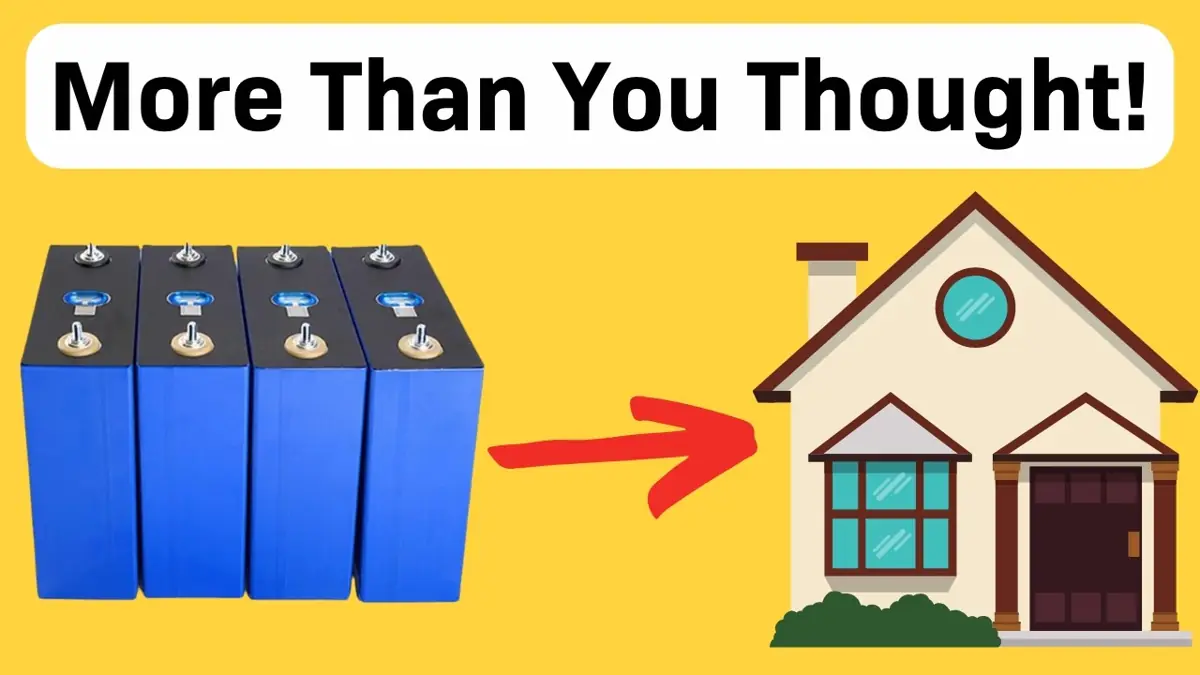
How many batteries you need to go off grid comes down to three numbers: daily electricity use, cloudy days you want to ride through, and how deeply your battery chemistry can safely discharge. This guide turns those into a real bank size, with worked examples from weekend cabin to full-time home, so you buy the right bank once.
- Battery bank size = daily kWh × days of autonomy ÷ usable fraction of the battery.
- 2 to 3 days of autonomy is the standard target; full-time off-grid homes lean toward 3.
- Plan LiFePO4 at 80% depth of discharge; lead-acid at 50%.
- A typical efficient home using 10 kWh per day needs roughly a 30 kWh LiFePO4 bank for 3-day autonomy.
- Buy the whole bank at once as matched batteries, and build at 48V.
The Three Numbers That Decide Bank Size
Forget rules of thumb like “four batteries per kilowatt of panels.” Banks are sized from consumption, not the array, and all three inputs are knowable before you spend a dollar.
Number 1: daily use in kWh. Off-grid cabins often land at 2 to 5 kWh per day, efficient full-time homes at 8 to 15 kWh. The average grid-connected American home is near 30 kWh per day per EIA data, but off-grid households run leaner because efficiency pays twice off grid. A Kill A Watt meter and a week of measurement beat any estimate.
Number 2: days of autonomy. How many sunless days the bank must carry you alone. Two days is the common minimum; three is the comfortable standard for full-time living.
Number 3: usable fraction (depth of discharge). The share of the battery’s rated capacity you plan to actually use: 80% for LiFePO4, 50% for lead-acid.
The formula: rated bank kWh = daily kWh × days of autonomy ÷ inverter efficiency (0.9) ÷ depth of discharge. The rest of this guide is just applying that formula with judgment.
How Many Days of Autonomy Do You Need?
Days of autonomy is a bet on your weather and your tolerance for running a generator. Here is how the choice usually breaks down:
1 day: only for grid-tied backup or fair-weather weekends. One cloudy day and you are rationing.
2 days: the practical minimum for cabins. Covers a normal cloudy spell; a generator handles the rare long one. See our off-grid cabin sizing guide.
3 days: the full-time standard. Three sunless days happen every winter in most climates; with 3 days of autonomy you sleep through them.
4 to 5 days: for cloudy northern climates or generator refusers. Each extra day costs roughly $1,500 to $2,500 in lithium, so compare against a $1,000 generator first.
A generator and battery autonomy are substitutes: 2 days of batteries plus a generator is usually cheaper than 4 days of batteries alone. Size for the common gray spell; let the generator cover the rare gray week.
Depth of Discharge Explained
Depth of discharge (DoD) is the percentage of rated capacity you actually use. Usable capacity, not the label number, is what powers your house.
LiFePO4 lithium: plan on 80% DoD. Cells can technically hit 100%, but regular full drains shorten cycle life. At 80%, quality LiFePO4 delivers 3,000 to 6,000 cycles, a decade-plus of daily use. A 48V 100Ah server-rack battery (5.12 kWh) therefore gives about 4.1 kWh of planned usable storage.
Lead-acid (flooded or AGM): plan on 50% DoD; deeper discharges sharply shorten an already short life (500 to 1,000 cycles at 50%). A 200Ah 12V lead-acid rated 2.4 kWh gives only 1.2 kWh usable, which is why lead-acid looks cheap until you double it to match lithium.
Always compare dollars per usable kWh, not per rated kWh; that habit keeps you from buying a “cheap” bank that costs more than lithium over its life. Our LFP vs NMC comparison covers lithium chemistries in depth.
Worked Example: 10 kWh per Day
Take an efficient full-time home using 10 kWh per day, wanting 3 days of autonomy, with LiFePO4 batteries:
10 kWh × 3 days = 30 kWh needed. ÷ 0.9 inverter efficiency = 33.3 kWh usable. ÷ 0.8 DoD = about 42 kWh rated. That is the textbook answer, so why does everyone quote a 30 kWh bank for this case?
In practice the two derates rarely stack at worst case, so designers use the simpler rule: daily use × days = usable target, then buy roughly 25% more rated capacity. So 10 × 3 = 30 kWh usable target, and a 30 kWh rated LiFePO4 bank (six 48V 100Ah server-rack batteries) is the classic build: about 24 kWh of planned usable storage, or 2.5 to 3 real days for a 10 kWh/day home. At $1,000 to $1,500 per 5.12 kWh unit, that bank costs $7,000 to $12,000 DIY.
The table below applies the same practical method across common household sizes, all assuming LiFePO4 at 3 days of autonomy:
| Daily use | Usable target (× 3 days) | Rated LiFePO4 bank | 48V 100Ah units needed |
|---|---|---|---|
| 3 kWh (frugal cabin) | 9 kWh | ~11 kWh | 2 |
| 5 kWh (weekend cabin) | 15 kWh | ~19 kWh | 4 |
| 10 kWh (efficient home) | 30 kWh | ~36 kWh | 7 |
| 15 kWh (typical home) | 45 kWh | ~56 kWh | 11 |
| 20 kWh (heavy use) | 60 kWh | ~75 kWh | 15 |
Round up to whole batteries, and remember winter: if panels cannot refill the bank daily in December, even a big bank walks down to empty. Batteries store energy; only the array replaces it. For full system costs, see our 5 kW off-grid cost guide.
LiFePO4 vs Lead-Acid
For a new off-grid bank in 2026, LiFePO4 is the default and lead-acid the exception:
| Factor | LiFePO4 | Lead-acid (flooded/AGM) |
|---|---|---|
| Usable capacity | 80% of rated | 50% of rated |
| Cycle life | 3,000 to 6,000 cycles | 500 to 1,000 cycles |
| Typical lifespan | 10 to 15 years | 3 to 5 years |
| Cost per usable kWh (upfront) | $200 to $300 | $150 to $250 |
| Maintenance | None | Watering, equalizing, ventilation |
| Charging below freezing | Not allowed (damages cells) | Allowed (reduced capacity) |
Pros
- LiFePO4: far longer life, no maintenance, faster charging, lighter per usable kWh
- LiFePO4: cheaper over a 10-year horizon despite higher sticker price
- Lead-acid: lower upfront cost and tolerates freezing garages
Cons
- LiFePO4: higher upfront cost; cannot charge below 32°F without heated models
- Lead-acid: half the capacity is usable, short life, regular maintenance, hydrogen venting needed
- Lead-acid: usually more expensive per usable kWh over the system’s life
Lead-acid’s one case: an unheated outbuilding in a freezing climate, and even there heated LiFePO4 models have mostly closed the gap. Victron’s lithium battery documentation covers charging parameters and temperature limits in engineering detail.
Typical Bank Sizes by Home
In the real world, assuming LiFePO4 and 2 to 3 days of autonomy:
Weekend cabin (3 to 5 kWh/day): 10 to 20 kWh rated, 2 to 4 server-rack batteries, the most common DIY off-grid bank in America.
Efficient full-time home (8 to 12 kWh/day): 25 to 40 kWh rated, 5 to 8 server-rack batteries; the classic 30 kWh bank lives here.
Typical family home (15 to 20 kWh/day): 45 to 75 kWh rated. At this size, compare against the packaged-battery route in our Powerwall sizing guide.
On the grid and sizing for outages instead? You only cover essentials for hours, not days. See sizing a home battery for outages.
Mistakes That Kill Battery Banks
Buying too little and planning to “add later.” Buy one matched bank: a new battery wired to year-old batteries ages at their pace.
Sizing for summer. December gives you the least sun and the most heating load. A bank that is generous in July can be empty by New Year. Size autonomy for winter, or own a generator.
Charging lithium below freezing. Charging LiFePO4 below 32°F damages cells; keep batteries in a conditioned space or buy heated models.
Building a big bank at 12V. A 30 kWh bank at 12V moves enormous current, meaning absurd cable sizes. Above about 3 kW of inverter or 10 kWh of storage, build at 48V.
No battery monitor. Voltage alone says little about lithium state of charge; a $150 shunt-based monitor (Victron SmartShunt) shows the real number and pays for itself the first time it prevents an over-discharge.
Forgetting the array. Batteries store energy; they do not make it. A huge bank with a tiny array just takes longer to go empty.
How long do off-grid batteries last?
Quality LiFePO4 lasts 10 to 15 years (3,000 to 6,000 cycles) in daily service; lead-acid lasts 3 to 5. Heat, chronic over-discharge, and sub-freezing charging kill batteries early; a monitor and sensible DoD limits prevent most of it.
Can I add more batteries to my bank later?
You can, but new batteries degrade toward the old ones’ level. Buy the full bank as matched units on day one; if you must expand, do it within the first few months.
What voltage should my battery bank be: 12V, 24V, or 48V?
48V for anything beyond a tiny cabin. Higher voltage means lower current, thinner wire, smaller breakers, less heat loss, and the 48V server-rack market has 2026’s best dollars-per-kWh.
Do solar batteries work in winter?
Yes, with caveats: size the array for short winter days, and never charge LiFePO4 below freezing (keep them warm or buy heated models). Lead-acid tolerates cold charging but loses capacity.
How many Tesla Powerwalls equal a DIY lithium bank?
One Powerwall 3 stores 13.5 kWh usable, so a 30 kWh DIY LiFePO4 bank holds a bit more than two Powerwalls’ worth at roughly a third of the installed cost per kWh. The trade-off: warranty, integration, and no installer to call.
Ready to compare real solar prices?
Get free, no-pressure quotes from vetted local installers and see what solar costs for your roof.