
A power purchase agreement and a solar loan both put panels on your roof with little money down, but they are fundamentally different deals. A PPA rents you the power; a loan buys you the power plant. Over 20 years, that distinction is usually worth five figures. Here is the contract-by-contract math.
- A PPA charges per kWh produced, typically starting 10 to 30 percent below your utility rate, with annual escalators of 2.9 to 3.9 percent.
- A solar loan’s payment is fixed; once it is paid off, your power is nearly free.
- Over 20 years, the loan usually costs $15,000 to $25,000 less than a PPA for the same system.
- PPA savings depend entirely on the race between the escalator and utility rate growth.
- PPA end-of-term buyouts are priced at fair market value, which is negotiable in practice.
How a Solar PPA Works
Under a power purchase agreement, a solar company installs panels on your roof at no cost, owns and maintains them, and sells you the electricity they produce at a contracted per-kWh rate. If your utility charges $0.22 per kWh, the PPA might start at $0.16 per kWh, saving you 6 cents on every solar kilowatt-hour from day one. You pay only for what the system produces, which neatly aligns the company’s incentive with keeping the system healthy.
The catch is the escalator: most PPAs raise the per-kWh rate 2.9 to 3.9 percent every year for 20 or 25 years. The company also claims any incentives the system generates, which is part of how it offers $0 down. Terms run 20 to 25 years, and the contract transfers to a home buyer much like a lease. For the broader lease-versus-buy picture, see our 25-year comparison.
How a Solar Loan Works
A solar loan is simpler: you borrow the installed cost, you own the system from day one, and your monthly payment never changes. Typical solar loans run 10 to 25 years at rates roughly between 5 and 9 percent in 2026, depending on term and credit. The payment is fixed while utility rates rise around it, which is where the long-term advantage compounds.
Watch for dealer fees, the solar industry’s least-loved pricing trick. Many “low-rate” solar loans (2.99 or 4.99 percent) bake a 15 to 30 percent dealer fee into the system price, meaning a $22,000 system becomes $27,000 on paper to fund the cheap rate. Compare loans by total amount repaid, not by advertised APR, and get at least one quote with a plain bank or credit-union loan for comparison. Our cash versus financed analysis shows how to do that comparison properly.
| Feature | Solar PPA | Solar loan |
|---|---|---|
| Upfront cost | $0 | $0 down available |
| Who owns the system | The PPA company | You, from day one |
| Payment structure | Per kWh, escalating | Fixed monthly |
| Maintenance | Company’s responsibility | Yours |
| Incentives | Go to the company | Yours (confirm with a tax pro) |
| Home sale | Buyer must qualify | Pay off or transfer loan |
20-Year Cost Comparison
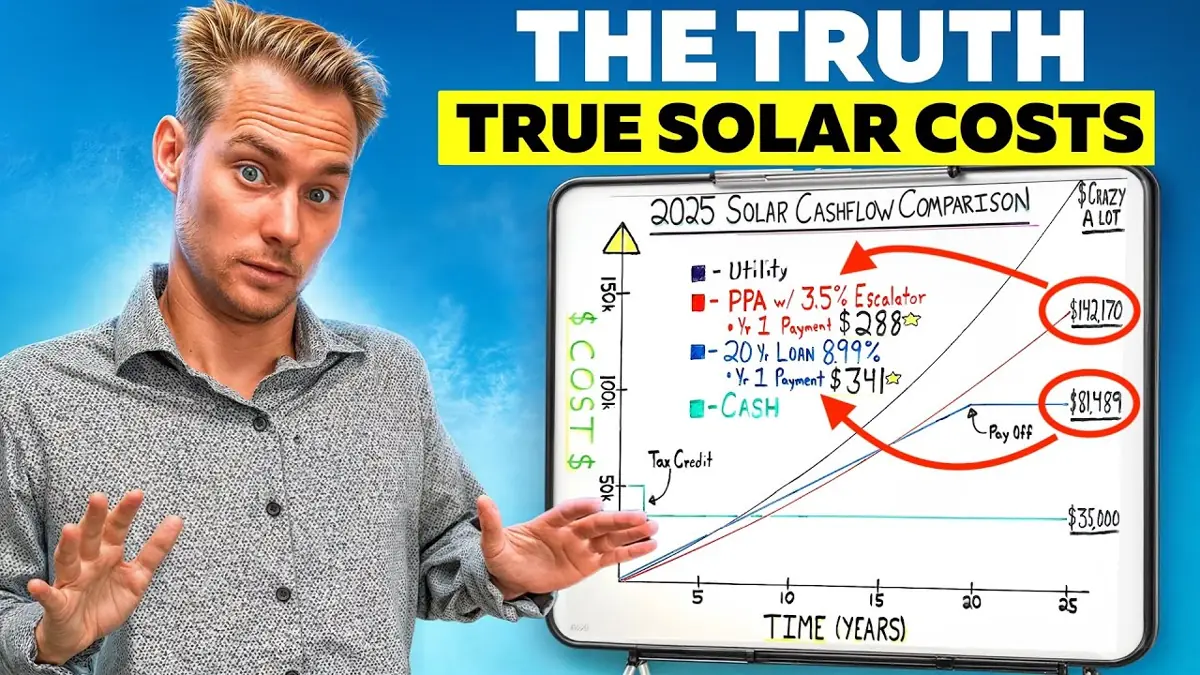
Take an example 8 kW system producing 12,000 kWh in year one. The PPA starts at $0.16 per kWh with a 2.9 percent escalator over 20 years. The loan covers a $22,000 system at 7 percent for 20 years, about $170 a month. Utility power starts at $0.22 and rises 4 percent annually. Illustrative example, not a quote.
| 20-year figure | PPA | Solar loan |
|---|---|---|
| Total paid | ~$44,500 | ~$40,800 |
| Utility bills avoided | ~$65,000 | ~$65,000 |
| Net 20-year benefit | ~$20,500 | ~$24,200 |
| Years 21 to 25 (extra) | Still paying PPA rate | Nearly free power |
The 20-year gap looks modest, under $4,000, because the loan’s interest eats much of the ownership advantage early. But the loan ends at year 20 while the PPA keeps billing, often at rates that have escalated uncomfortably close to utility prices. Extend to 25 years and the loan pulls ahead by $15,000 to $25,000, since years 21 to 25 deliver nearly free power to the owner while the PPA customer keeps paying. This tail effect is the single most underappreciated part of the comparison.
Escalators: The PPA’s Hidden Price
Run the escalator race explicitly. At 2.9 percent annual growth, a $0.16 PPA rate becomes about $0.28 in year 20. If utility rates grew 4 percent from $0.22, they reach about $0.48, and the PPA still saves you plenty. But if utility rates grew only 2 percent, they reach $0.33, and your PPA “discount” has shrunk to 5 cents. At a 3.9 percent PPA escalator against 2 percent utility growth, the PPA rate can actually overtake the utility rate before the term ends.
This is not hypothetical in slow-rate-growth states. The PPA is a bet that your utility will keep raising rates faster than your escalator, and over 20 years that bet usually wins, but not always and not everywhere. Some PPA providers offer fixed-rate (0 percent escalator) options or lower escalators for a slightly higher starting rate; always ask. A fixed-rate PPA removes the race entirely and is often the best version of the product. Read the escalator clause the way our quote-reading guide teaches: it is the most expensive paragraph in the contract.
Buyouts and End-of-Term Options
PPA contracts include buyout provisions, typically available after year 5 or 6, priced at the greater of a contract schedule or fair market value. In practice, “fair market value” for a mid-life rooftop system is often lower than sellers expect, sometimes $1.00 to $1.50 per watt for a 10-year-old system, which gives you negotiating room the contract does not advertise. Third-party appraisals can support a lower figure if you push.
At term end, you can usually renew at a new rate, buy the system, or have it removed. Removal sounds clean but leaves you with roof penetrations to repair and no power source. Most long-term PPA customers who are happy with the system negotiate a buyout in the final years, converting to ownership just as the panels enter their free-power phase. If you are comparing this path against buying from the start, 2026 installed prices tell you what ownership would have cost.
Pros of a PPA
- $0 down with immediate bill savings.
- You pay only for power actually produced.
- Maintenance and performance risk sit with the company.
Cons of a PPA
- Escalators can erase the discount over 20 years.
- You never own the asset or its incentives.
- Buyer must qualify to assume the contract at sale.
Which Contract Fits Which Homeowner
Choose the loan if you have decent credit, plan to stay in the home long term, and want maximum lifetime value. The fixed payment plus the free-power tail after payoff is the strongest financial structure for most homeowners who can qualify. Choose the PPA if your credit or cash flow rules out a loan, if you value zero maintenance responsibility highly, or if your roof situation makes you want the company’s performance guarantee backing the production.
Either way, get both quotes for your actual roof. A surprising number of homeowners sign a PPA without ever seeing what a loan would have cost, because the PPA salesperson arrived first. An hour of comparison shopping is worth thousands here. And whatever you sign, verify the company: our 2026 financing guide covers how to vet providers before you commit to a two-decade relationship.
Is a solar PPA ever cheaper than a loan?
Over the full term, rarely, but it can be in the early years since PPA payments start low while loan payments are flat and higher. If you might move within 5 to 7 years, the PPA’s low early payments can win on the time you actually own the home.
What credit score do I need for a solar PPA?
Most PPA providers look for mid-600s or higher, similar to solar leases. Requirements vary by provider and some are more flexible than others, so ask before assuming you do not qualify.
Can I get out of a solar PPA early?
Early termination usually means buying out the system at the contract’s defined price, which can be expensive in the early years. Some contracts allow transfer to a buyer as the practical exit. There is rarely a free walk-away option.
Does the PPA company really handle all maintenance?
Yes, that is a core part of the deal: monitoring, repairs, and inverter replacements are the owner’s responsibility, and under a PPA that is the company. Keep records anyway, since production directly determines your bill.
Ready to compare real solar prices?
Get free, no-pressure quotes from vetted local installers and see what solar costs for your roof.