
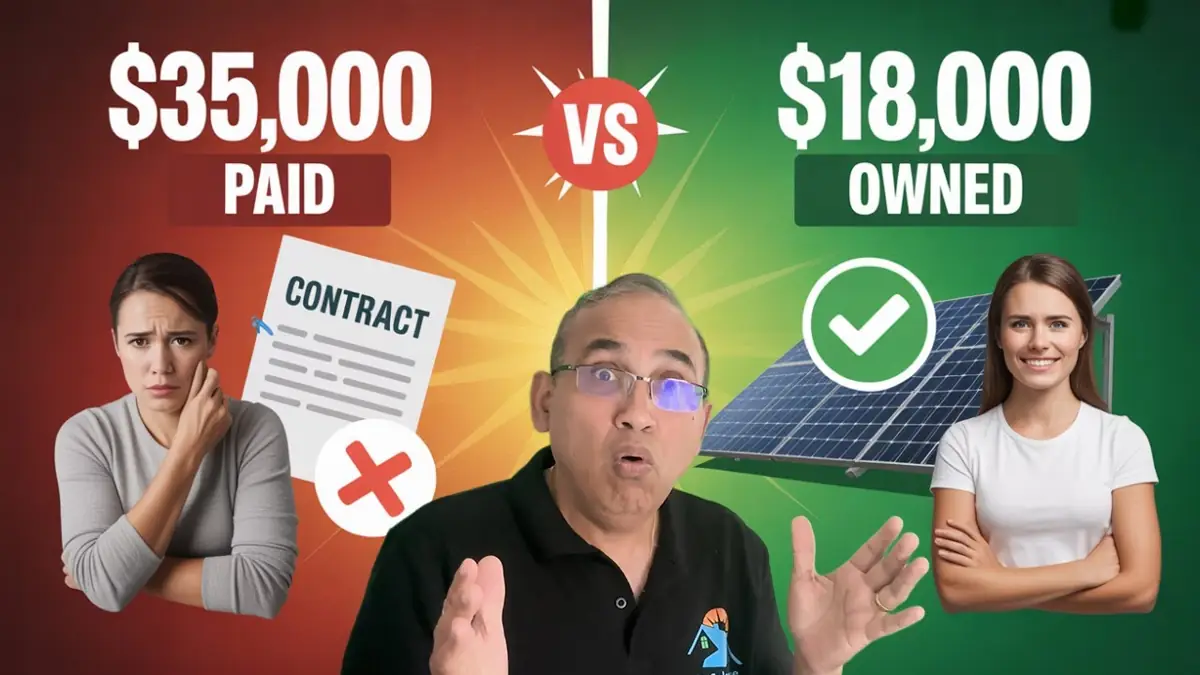
The lease-versus-buy question looks close in year one and lopsided by year twenty-five. A leased system can cost $40,000 or more extra over its lifetime compared with buying the same hardware outright. This is the full 25-year math, with every assumption shown, so you can see exactly where the money goes.
- Over 25 years, leasing the same system typically costs $35,000 to $45,000 more than buying with cash.
- Financing sits in the middle: interest adds cost, but ownership keeps the long-term upside.
- Lease escalators of 2.9 to 3.9 percent compound relentlessly, erasing much of the promised savings.
- Owned solar adds home value and transfers cleanly at sale; leased solar adds complications.
- Leasing still makes sense for households that cannot use tax incentives or want zero maintenance risk.
How Buying and Leasing Each Work
Buying means you own the equipment on your roof. You pay cash or take a solar loan, you receive (or forgo) any incentives, you handle maintenance, and you keep every dollar of electricity the system produces for 25-plus years. After the payback period, your power is essentially free.
Leasing means a solar company owns the equipment and sells you its output at a fixed monthly payment, usually with an annual escalator. You pay nothing upfront, the company handles maintenance and monitoring, and you save the difference between the lease payment and your old utility bill. At the end of the 20 or 25 year term, you can renew, buy the system at fair market value, or have it removed. PPAs work similarly but charge per kilowatt-hour instead of a flat monthly fee, and cash versus financed buying is its own comparison worth reading.
Year-One Costs: Cash, Loan, and Lease Side by Side
Take an example 8 kW system at $2.75 per watt, or $22,000 installed, a realistic 2026 price from current market data. Here is what each path costs in year one. This is an illustrative example, not a quote.
| Cash purchase | Solar loan | Solar lease | |
|---|---|---|---|
| Upfront cost | $22,000 | $0 down | $0 down |
| Monthly payment | $0 | ~$155 (25-yr, ~7%) | ~$150 |
| Year-one outlay | $22,000 | ~$1,860 | ~$1,800 |
| Year-one bill savings | ~$1,840 | ~$1,840 | ~$1,840 |
| Year-one net | -$20,160 | ~-$20 | ~+$40 |
Year one flatters the lease: almost no money out of pocket and immediate small savings. The loan looks similar monthly. Cash looks painful. But year one is the wrong frame. Solar is a 25-year asset, and the financing structure determines who captures the decades of value after payback. One 2026 note: the federal 25D residential credit ended for systems installed after December 31, 2025, so this comparison assumes no federal credit. If you installed in 2025 and claimed it via Form 5695, buying looked better still.
The 25-Year Totals That Decide It
Now stretch the same example over 25 years. Assume the system produces 12,000 kWh in year one, degrading 0.5 percent annually, against a utility rate starting at $0.17 per kWh and rising 4 percent a year. The lease escalates 2.9 percent annually. The loan runs 25 years at about 7 percent.
| 25-year figure | Cash purchase | Solar loan | Solar lease |
|---|---|---|---|
| Total paid for the system | $22,000 | ~$46,600 | ~$64,800 |
| Maintenance (inverter reserve) | ~$2,500 | ~$2,500 | $0 |
| Total lifetime cost | ~$24,500 | ~$49,100 | ~$64,800 |
| 25-yr utility bills avoided | ~$80,000 | ~$80,000 | ~$80,000 |
| Net 25-year benefit | ~$55,500 | ~$30,900 | ~$15,200 |
The gap is stark: cash beats leasing by roughly $40,000 over 25 years on the same roof. The loan lands in the middle, costing about $25,000 more than cash in interest but still delivering double the lease’s net benefit. These are illustrative figures, and your numbers will differ, but the ordering is robust across almost any realistic inputs: cash first, loan second, lease last. The lease still saves money versus doing nothing; it just captures far less of the value your roof creates.
How Lease Escalators Quietly Change the Math
The escalator is the lease’s hidden engine. A 2.9 percent annual increase sounds trivial, but over 25 years it turns a $150 monthly payment into about $298 in the final year. Total payments roughly double what the starting rate suggests. At a 3.9 percent escalator, common in some contracts, the final-year payment hits roughly $374 and lifetime payments approach $75,000.
Whether the lease still saves you money depends entirely on the race between the escalator and your utility’s rate growth. If utility rates rise 5 percent a year, a 2.9 percent lease escalator leaves you winning by a widening margin. If utility rates rise only 2 percent, the lease payment eventually overtakes what the grid would have cost, and the “savings” go negative in the later years. Before signing any lease, model both rates explicitly and ask the salesperson to show you the year-by-year comparison in writing. Fixed-escalator leases also compare poorly with owned systems paired with batteries under time-of-use rates, where owners capture peak-price arbitrage the lease company would otherwise keep.
What Ownership Gives You Beyond the Numbers
Money is not the only difference. Owned solar is your asset: it typically adds 3 to 4 percent to home resale value according to multiple studies, it transfers to buyers with nothing more than a disclosure, and you control every decision about the equipment. Leased solar is someone else’s asset on your roof: it adds little appraised value, the buyer must qualify with the leasing company, and selling a home with a lease adds weeks of paperwork and a second underwriting hurdle.
Ownership also means you choose the equipment, the installer, and the monitoring, and you keep any state or utility incentives. (Confirm incentive eligibility with a tax professional, since lease structures assign some incentives to the leasing company by design.) The Department of Energy’s homeowner guide walks through ownership considerations in neutral detail, and DSIRE lists the state incentives an owner can claim.
Pros of buying
- Lowest 25-year cost by a wide margin.
- Full home-value premium at resale.
- You keep all incentives and production upside.
Cons of buying
- Large upfront cost or years of loan payments.
- You own maintenance and inverter replacement risk.
- Payback takes 8 to 12 years before the free-power phase.
When Leasing Still Makes Sense
Leasing is not a scam; it is a financing product that fits specific situations. If you cannot use tax incentives (low tax liability, and note the 2026 federal landscape), the lease company’s ability to monetize incentives it can claim may partially offset the lifetime premium. If your roof or finances make ownership impractical but your utility rates are high, a lease still beats renting power from the grid forever. And some homeowners simply value zero maintenance responsibility and zero upfront cost over maximum lifetime return.
The key is entering with eyes open: negotiate the escalator down (some lessors offer 0 to 1.9 percent escalators or fixed-rate options if you ask), confirm the buyout terms, and verify the transfer process before you need it. A well-negotiated lease with a low escalator is a reasonable product. An unexamined lease at a 3.9 percent escalator signed because the salesperson emphasized “$0 down” is how the $40,000 gap happens.
Related Guides: Keep Comparing
This comparison is one piece of the financing puzzle. Keep going:
- Solar PPA vs Loan: Which Contract Costs Less Over 20 Years?
- Cash vs Financed Solar: The True Cost Difference Over a System Lifetime
- Sunrun vs Tesla Energy vs Local Installer: Price and Service Compared
- Ground-Mount vs Roof-Mount Solar: When a Backyard Array Wins
Is it better to lease or buy solar panels in 2026?
Buying usually wins on lifetime cost by $30,000 to $45,000 over 25 years. Leasing makes sense if you want zero upfront cost, cannot handle maintenance, or cannot use ownership incentives. Run both quotes on the same roof before deciding.
What happens at the end of a solar lease?
Most contracts offer three options: renew the lease, buy the system at its fair market value, or have the company remove it at their cost. Check your contract’s specific terms, since removal and buyout details vary.
Can I buy out my solar lease early?
Usually after year 5 or 6, at a price set by your contract’s buyout schedule or fair market value, whichever is greater. An early buyout can make sense before selling your home.
Do solar leases have prepayment penalties?
Most residential solar leases do not have traditional prepayment penalties, but the buyout price is contractually defined and may exceed what you expect. Read the buyout clause before signing, not when you want out.
Does a solar lease affect my credit?
Applying involves a credit check, and the lease obligation may appear on your credit report depending on the lessor’s reporting practices. Missed lease payments can damage your score like any missed bill.
Ready to compare real solar prices?
Get free, no-pressure quotes from vetted local installers and see what solar costs for your roof.