
A 10 kW solar system is bigger than the average American home needs, but “average” hides a lot. For homes with central AC, an EV, or a pool, 10 kW is right-sized, not overkill. For a small efficient home, it is too much system. Here is how to tell which camp you are in.
- The average US home uses about 880 kWh per month (per EIA data), which a 6 to 8 kW system covers in most states. 10 kW suits above-average users.
- A 10 kW system produces roughly 12,000 to 18,000 kWh per year depending on location, and costs about $25,000 to $35,000 installed.
- You likely need 10 kW if you have central AC plus an EV, a pool, or electric heat.
- Utilities often cap systems at 100 to 120 percent of your historical usage, so you cannot always build 10 kW just because you want to.
The short answer
For the statistically average family, yes, 10 kW is more than needed. The EIA puts average US residential usage near 880 kWh per month (about 10,500 kWh per year), which a 7 to 8 kW system covers in most states. But few families are statistically average. Add central air conditioning in a hot state, an electric vehicle, a pool pump, or electric heat, and 10 kW goes from overkill to about right. The question is never “is 10 kW too big” in the abstract; it is “is 10 kW too big for your usage.”
If your bills run $150 or less in a cheap-power state, 10 kW is almost certainly oversized. If they run $200-plus with AC or an EV in the mix, 10 kW is a sensible target. When in doubt, let 12 months of kWh history decide, not a round number. Our $200 bill sizing guide walks through the bill-to-system math step by step.
What the average family actually uses
Let’s ground this in numbers. EIA data consistently shows average US household electricity consumption around 10,500 to 11,000 kWh per year, though it varies enormously: Louisiana homes average over 14,000 kWh (cheap power, heavy AC) while California homes average under 7,000 kWh (expensive power, mild coastal climate, efficiency culture).
A 10 kW system in a middle-of-the-country location (4.5 peak sun hours, 1,400 kWh per kW per year) produces about 14,000 kWh per year. That covers the average home with roughly 30 percent to spare. In Phoenix it produces closer to 18,000 kWh; in Seattle, about 12,000. So “overkill” depends on both your usage and your zip code: 10 kW in Seattle for an average home is modestly oversized, while 10 kW in Phoenix for that same home is significantly oversized.
The practical definition of overkill: a system that routinely produces much more than you use, in a state where excess exports earn little. Under generous net metering, oversizing is mostly harmless (credits bank for later). Under NEM 3.0-style rules with low export values, every surplus kWh is nearly wasted money.
What 10 kW produces and costs
| Location type | Annual production (approx) | Typical installed cost | Panels at 400W |
|---|---|---|---|
| Southwest | 16,000 to 18,000 kWh | $25,000 to $32,000 | 25 |
| Texas / Southeast | 14,000 to 16,000 kWh | $25,000 to $33,000 | 25 |
| Midwest / Mid-Atlantic | 12,000 to 14,000 kWh | $26,000 to $34,000 | 25 |
| Northeast / Northwest | 10,000 to 12,000 kWh | $27,000 to $35,000 | 25 |
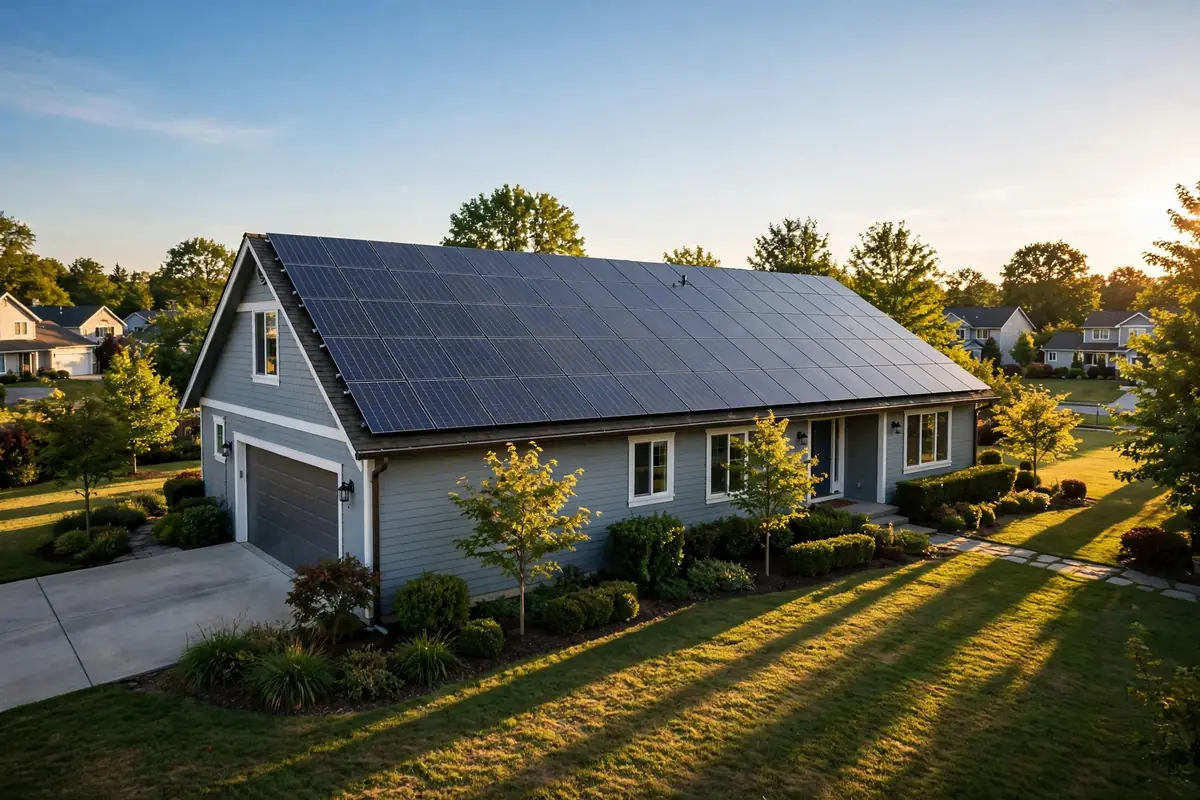
At $2.50 to $3.50 per watt, 10 kW costs roughly $25,000 to $35,000 installed before incentives. Per-watt pricing at this size is better than small systems but not as sharp as 15 kW-plus installs. Twenty-five panels need about 450 to 500 square feet of usable roof, which most single-family homes have on a decent solar face.
Remember that the federal 25D credit ended for 2026 installs, so these are out-of-pocket numbers unless state or utility incentives apply. That makes right-sizing more valuable: every unnecessary kilowatt is $2.50 to $3.50 per watt you will not get back via tax credit.
Who genuinely needs 10 kW
You are in 10 kW territory if your annual usage sits between roughly 12,000 and 18,000 kWh. That typically means two or more of the following: central air conditioning in a hot climate (3,000 to 6,000 kWh per year for cooling alone), an electric vehicle driven 12,000 miles per year (3,000 to 4,000 kWh), a pool pump (2,000 to 3,000 kWh), electric water heating or electric heat, or a large household with lots of occupants and devices.
Future plans count too. If the EV arrives next year or the kids’ gaming PCs multiply, sizing for documented near-future load is smart, provided your utility’s oversizing cap allows it. Our 20 percent rule guide explains strategic oversizing in detail. Very high-usage homes should read sizing for a 2,000 kWh home instead, since 10 kW will not cover them. As a rough rule, each EV you plan to charge at home adds about 3,000 to 4,000 kWh per year at 12,000 miles, which is roughly 2 to 3 kW of solar by itself.
Who should go smaller
Go smaller if your usage is under 10,000 kWh per year with no big electrification plans: small homes, gas heat and gas water heating, mild climates, energy-conscious households. A 6 to 8 kW system covers these homes fully and costs $6,000 to $10,000 less than 10 kW. That savings could fund a battery, which might do more for your bills than extra panels under time-of-use rates.
Also go smaller if your roof is the constraint. Twenty-five panels is a real footprint; if only 18 fit well, an 8 kW system at high offset beats a cramped 10 kW design with shading compromises. Quality of placement beats quantity of panels.
One more consideration: if your state has weak net metering, the economics of the last few kilowatts are poor. In that case, size to cover your daytime and evening usage (possibly with a battery) rather than chasing 100 percent annual offset.
Utility caps on oversizing
Most utilities limit residential systems to 100 to 120 percent of your last 12 months of usage. This rule exists to prevent people from building solar farms on residential rates. In practice, it means you usually cannot install 10 kW “for the future” unless your history supports something close to it. Some utilities accept documented load additions (a new EV registration, a pool permit); others require you to wait a year and show the usage.
If your usage justifies 8 kW and you want 10 kW for a car arriving in six months, talk to your installer about the utility’s specific process before assuming. The cap is the most common reason right-sized designs get trimmed, and it is easier to navigate with documentation than with arguments.
How many panels is 10 kW?
Twenty-five panels at 400W each, 24 at 430W, or 22 at 460W. Higher wattage means fewer panels, not more total power.
Can a 10 kW system run a whole house?
Energy-wise, it can cover a whole house using 12,000 to 16,000 kWh per year. Power-wise, the inverter (not the panels) determines what runs at once. Outage backup is a separate battery question.
Is 10 kW enough to charge an EV?
It can cover an EV driven 12,000 miles per year (about 3,500 kWh) plus a typical household, depending on location. Heavy drivers or two EVs push toward larger systems.
What is the payback on a 10 kW system in 2026?
Typically 8 to 12 years without the federal credit, depending on your rates and sun. High-rate states with good sun are at the short end. See our 2026 worth-it guide for the full economics.
Will 10 kW cover two EVs?
Probably not fully. Two EVs driven 12,000 miles each add roughly 7,000 kWh per year, on top of a typical household’s 10,000 kWh. That pushes total usage toward 17,000 kWh, which needs 12 kW or more in most states. One EV plus a typical home is the comfortable 10 kW case.
Should I get 10 kW now or start smaller and expand?
Starting at the right size now is almost always cheaper: expansions cost more per watt and may need new permits and inverter capacity. Only start small if budget truly forces it.
Ready to compare real solar prices?
Get free, no-pressure quotes from vetted local installers and see what solar costs for your roof.