
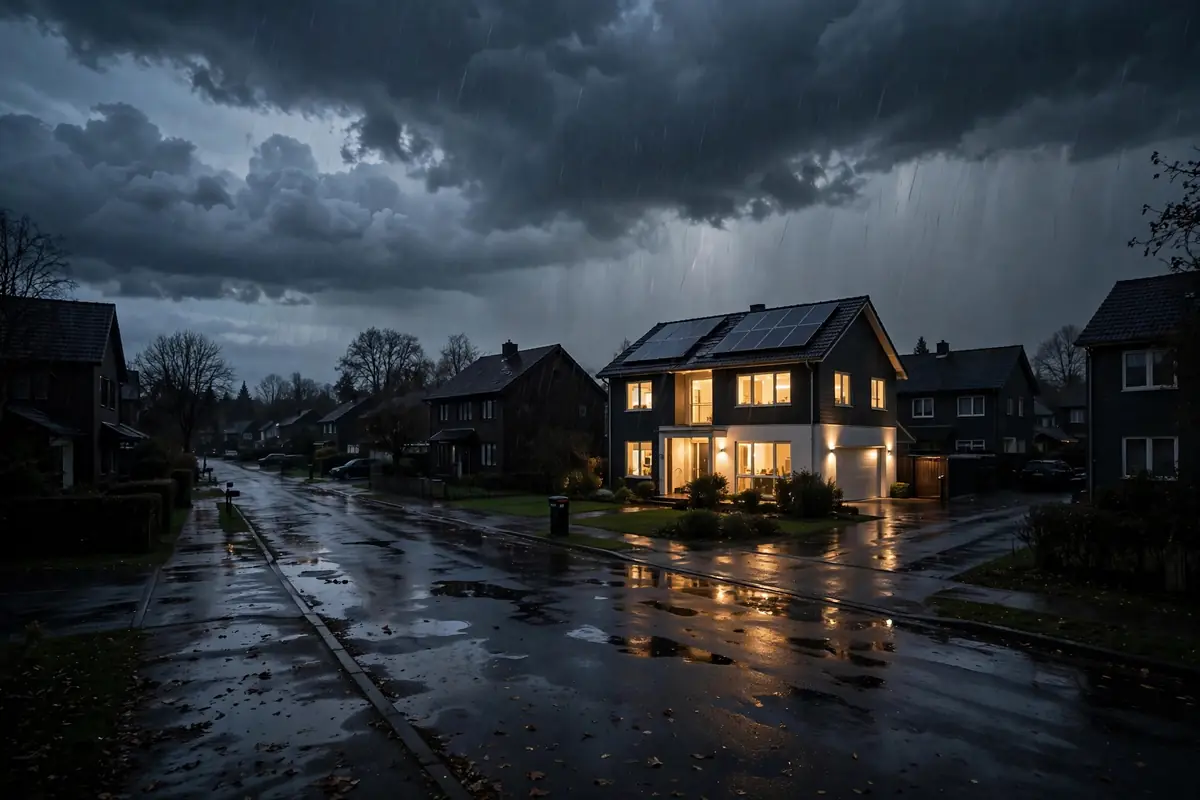
When the grid goes down, your grid-tied solar panels shut down too, usually within two seconds. This is not a malfunction. It is a deliberate safety behavior called anti-islanding, required by electrical code across the US. Here is exactly what happens, step by step.
- Grid-tied solar inverters are required to disconnect within 2 seconds of a grid outage (UL 1741 / IEEE 1547).
- The reason is anti-islanding: preventing your panels from energizing power lines while utility crews work on them.
- Rapid shutdown (NEC 690.12) separately drops rooftop DC voltage to safe levels within seconds.
- Your panels resume automatically when the grid returns and stays stable for about 5 minutes.
- Only a battery with a backup gateway (or a specialized inverter setup) keeps solar running during an outage.
The millisecond timeline of a grid failure
Here is what happens inside your system when the grid fails at, say, 2:14 PM on a sunny afternoon. Times are approximate; the sequence is what matters.
T+0 milliseconds: The grid fails. Voltage and frequency on your home’s wiring collapse or swing wildly. Your panels are still producing full DC power; they have no idea anything happened yet.
T+16 to 100 milliseconds: Your inverter’s grid-monitoring circuits detect the anomaly. Every grid-tied inverter sold in the US continuously watches grid voltage and frequency, sampling many times per second. The moment readings leave the permitted window, the countdown starts.
T+100 ms to 2 seconds: The inverter opens its internal relays, electrically disconnecting your solar from your home’s wiring and the grid. Under UL 1741 and IEEE 1547, the inverter must cease energizing within 2 seconds; most modern inverters do it in a fraction of a second.
T+2 to 10 seconds: Rapid shutdown activates. Module-level electronics (microinverters or optimizers) drop the DC voltage on your roof to below 80 volts within the array boundary, per NEC 690.12. Your roof goes electrically quiet.
After: Your home is dark (unless you have battery backup). Your panels sit in the sun producing nothing, their DC output with nowhere to go. This state persists until the grid returns.
Anti-islanding: why the shutdown exists
An “island” is a section of the grid that keeps running while disconnected from the main system. If your solar kept feeding power during an outage, your home (and possibly your neighbors’ homes, through the transformer) would become an energized island. Utility lineworkers repairing the outage assume lines are dead. An unexpected island can kill them.
Anti-islanding is therefore not optional and not a manufacturer choice. It is baked into UL 1741, the safety standard every grid-tied inverter must pass, and into IEEE 1547, the interconnection standard utilities enforce. The Department of Energy publishes background on interconnection standards, and SEIA tracks how these codes evolve.
| Standard / code | What it requires | Applies to |
|---|---|---|
| UL 1741 | Cease energizing within 2 seconds of grid loss | All grid-tied inverters |
| IEEE 1547 | Voltage/frequency trip windows and reconnection timing | Utility interconnection |
| NEC 690.12 | Rapid shutdown: roof DC below 80V within 30 seconds | Rooftop array wiring |
| UL 9540 | Safety testing for energy storage systems | Battery backup systems |
The inverter must actively test for the grid’s presence (by monitoring voltage, frequency, and impedance signatures) and disconnect when it disappears. This is also why you cannot simply “flip a switch” to keep panels running in an outage: defeating anti-islanding would violate code, void warranties, and endanger workers.
Rapid shutdown: the second safety layer
Anti-islanding protects lineworkers. Rapid shutdown protects firefighters. A rooftop array in sunlight always has live DC wiring; even with the inverter disconnected, hundreds of volts can sit on the roof. NEC 690.12 requires that, when rapid shutdown is initiated (automatically on grid loss, or manually via a clearly labeled switch), conductors within the array boundary drop below 80 volts within 30 seconds, and conductors outside the boundary drop below 30 volts within 30 seconds.
In practice, microinverters (Enphase) handle this inherently: each panel’s DC is converted at the panel, so there is no high-voltage DC run across the roof at all. String-inverter systems use module-level power electronics (like SolarEdge optimizers or Tigo devices) that choke each panel’s output when the inverter stops communicating. Either way, the result is the same: within seconds of the outage, your roof is electrically inert.
What the panels themselves are doing
A common question: are the panels damaged by sitting in the sun with nowhere to send power? No. A solar panel with no load simply sits at open-circuit voltage; the absorbed sunlight becomes a small amount of heat instead of electricity. Panels are designed for this. They do it every time your inverter clips output on a cool sunny day, and they do it for their entire 25+ year life whenever production exceeds what the system can use.
The panels do not “know” the grid is down. They keep generating DC voltage at their terminals as long as photons arrive. It is the electronics downstream, the inverter and module-level devices, that refuse to pass it anywhere. Think of it like a faucet with the valve closed: pressure exists, but no water flows, and nothing is harmed.
Reconnection: how solar comes back
When utility power returns, your solar does not instantly roar back. The inverter watches the grid for a stabilization period, typically 5 minutes of steady voltage and frequency within limits, before reconnecting. This delay is also in the standards: it prevents your system from connecting to a grid that is still fluctuating during restoration.
After the stabilization timer expires, the inverter closes its relays, rapid-shutdown devices release, and production ramps up over seconds to minutes. If your monitoring app shows zero production for a few minutes after the lights come back, that is normal. If production has not resumed after 15 to 30 minutes of stable grid power, check the inverter for fault codes before calling your installer.
What changes with a battery
A battery with a backup gateway changes the sequence entirely. When the grid fails, the gateway disconnects your home from the grid in milliseconds (satisfying anti-islanding: your home is no longer connected to utility lines), then forms its own stable microgrid. Your solar inverter sees clean voltage and frequency from the battery system and keeps producing, charging the battery and powering your home. Our Powerwall 3 vs Enphase IQ Battery 5P comparison looks at the two most popular battery options for this setup.
This is the technical reason batteries are the answer to “why do my panels shut off.” The panels were never the problem; they needed a grid reference to operate, and the battery provides a substitute reference. Our practical blackout guide covers what you can actually run in this scenario, and our battery economics guide runs the payback math.
One technical footnote: not every battery backup is seamless. Whole-home backup with a large enough battery is effectively uninterruptible. Partial-home backup may drop non-backed-up circuits for a cycle or two during transfer. Ask your installer for the transfer specification if you have sensitive equipment.
Edge cases and misconceptions
“My neighbor’s solar stayed on during the outage.” Either they have battery backup, or what you saw was a brief ride-through. Inverters tolerate sub-second grid disturbances without disconnecting; only sustained outages trigger the full shutdown.
“Can’t I just disconnect from the grid manually and keep the panels running?” No. A standard grid-tied inverter cannot form its own grid; it needs an external voltage and frequency reference. Manual disconnection leaves you with a silent inverter and a dark house. (Specialized off-grid and hybrid inverters can form a grid, but that is a different equipment choice made at install time.)
“Do panels get damaged by repeated shutdowns?” No. Grid-loss shutdowns are electrically gentle: relays open, production stops, everything waits. Inverters are designed for thousands of such events.
“What about during brownouts?” If voltage sags but stays within the inverter’s ride-through window, production continues. If it sags below the threshold for the required duration, the inverter disconnects and waits for stabilization, same as a full outage. Flickering brownouts can cause repeated disconnect/reconnect cycles, which is annoying but harmless.
For the homeowner’s practical view (what works, what does not, and your options without a battery), read our companion piece: do solar panels work during a blackout without a battery. And if outage protection is the goal, the chemistry in your battery matters for longevity: see our LFP vs NMC guide.
How fast do solar panels shut off in a power outage?
The inverter must stop energizing within 2 seconds per UL 1741/IEEE 1547; most do it in well under a second. Rapid shutdown then drops rooftop DC voltage to safe levels within seconds.
Why can’t solar panels power my house during a blackout?
Grid-tied inverters need the grid’s voltage and frequency as a reference to operate, and anti-islanding rules require them to disconnect to protect lineworkers. Only a battery with a backup gateway can substitute for the grid reference.
Do I need to do anything when the power goes out?
No. The shutdown and the restart are fully automatic. Just wait for stable grid power; production resumes after about a 5-minute stabilization period.
Can outages damage my solar equipment?
No. Disconnecting on grid loss is a designed, routine event. The system handles it the same way it handles every sunset.
Will my panels work if I go off-grid with a battery?
Yes. A battery with a backup gateway forms a microgrid that your solar inverter treats as a valid grid reference, so panels keep producing during the outage and recharge the battery.
Ready to compare real solar prices?
Get free, no-pressure quotes from vetted local installers and see what solar costs for your roof.