
Every 2026 solar quote includes an inverter, and increasingly that inverter is a “hybrid” with battery-ready branding and a higher price. The question buyers should ask is blunt: will you actually add a battery? If yes, a hybrid can save you thousands later. If no, a plain string inverter does the same job for less. Here is how to decide without paying for readiness you never use.
- A hybrid inverter manages both solar panels and a battery from one box; a string inverter handles solar only.
- Hybrids typically cost $1,000 to $2,500 more than comparable string inverters.
- Buy the hybrid if you plan to add a battery within 3 to 5 years, live with frequent outages, or face time-of-use rates.
- A plain string inverter is fine if batteries are not in your plans and your roof is simple and unshaded.
- Microinverters (Enphase) are a third path: inherently battery-compatible through AC coupling.
What each inverter actually does
A string inverter is the original solar workhorse: one box, usually mounted near your electrical panel, converting the combined DC output of your panel strings into AC for your home. It is simple, efficient (98 percent or better), and cheap. Its limitation is architectural: it knows nothing about batteries. Adding storage later means installing a separate battery inverter alongside it, an AC-coupled retrofit that works fine but adds equipment and cost.
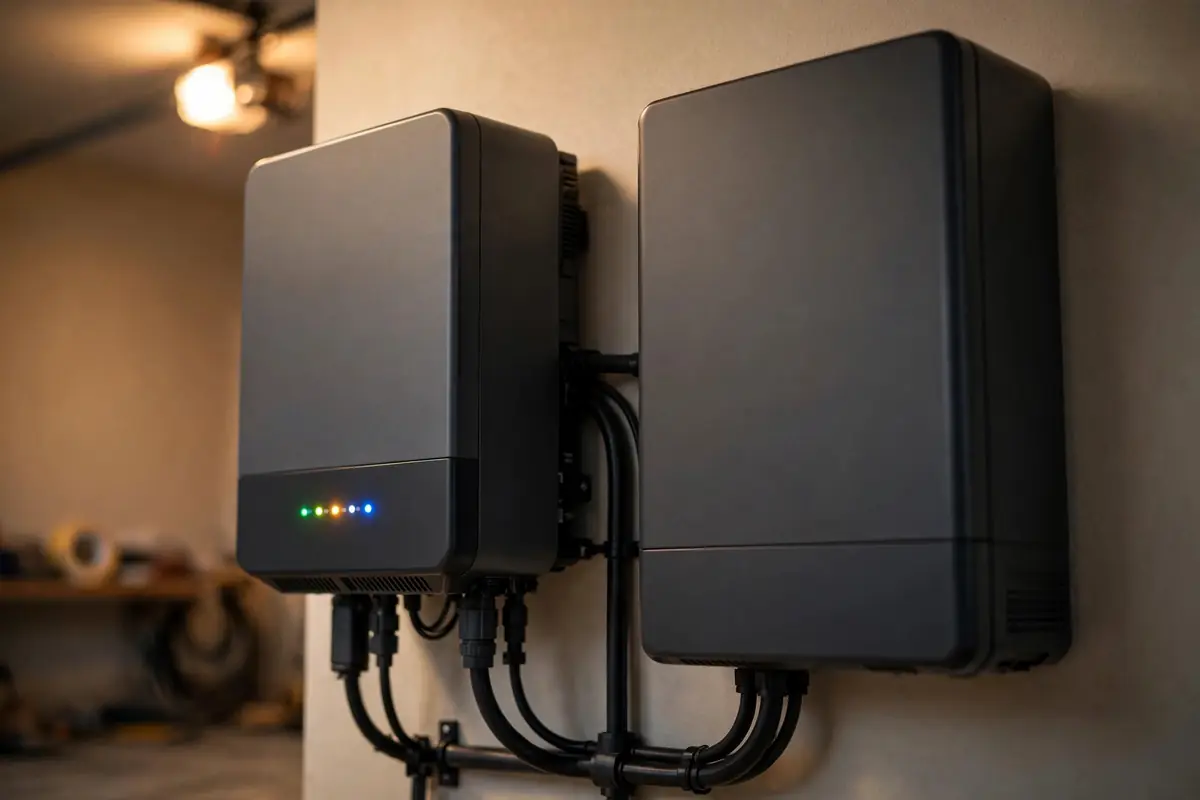
A hybrid inverter integrates battery management into the same box. It converts solar DC to AC for the house, directs surplus DC straight into the battery (more efficient than converting twice), and during outages, isolates your home from the grid and powers it from solar plus battery. One box, one monitoring platform, one warranty. The premium buys integration and future-proofing.
The hybrid advantage, concretely
The efficiency gain is real but modest. Charging a battery through a hybrid’s DC-coupled path avoids one AC-DC conversion round trip, saving roughly 3 to 5 percent of the energy versus AC-coupled retrofits. Over a decade of daily cycling, that is a few hundred kilowatt-hours, nice but not decisive.
The decisive advantages are cost timing and outage performance. Installing the hybrid now and the battery later typically costs $1,500 to $3,000 less overall than installing a string inverter now plus a separate battery inverter later, because you avoid duplicate labor, wiring, and a second box on the wall. During outages, integrated hybrids generally switch to backup power faster and manage the solar-battery handoff more smoothly than cobbled-together retrofits.
Time-of-use rates strengthen the case further. If your utility charges $0.45/kWh from 4 to 9 p.m. and $0.15/kWh overnight, a hybrid plus battery lets you store midday solar and spend it during the expensive window, an arbitrage the string inverter cannot do at all. In California’s NEM 3.0 world, this rate play is often the battery’s entire economic justification. The Department of Energy’s solar-plus-storage resources explain these rate interactions well, and DSIRE tracks which states still offer the net metering rules that make plain string inverters viable.
The case for a plain string inverter
Now the honest counter. If you are confident you will not add a battery, the hybrid premium buys nothing. A quality string inverter from SMA, Fronius, or SolarEdge converts power just as efficiently, costs less, and has fewer features to go wrong. For a simple unshaded roof in a net-metered state with reliable grid power, it remains the rational minimum.
Consider the Jacksons in Ohio: 9 kW system, full retail net metering, two outages in five years lasting under three hours each, no plans for a battery. Their installer quoted a hybrid at $1,800 over the string option. That $1,800 buys no savings and no resilience they would use. The string inverter is the right call, and the savings shorten their payback period by the better part of a year.
One caveat: “no battery plans” should be a confident no, not a vague maybe. Battery prices fall most years, outage anxiety rises most years, and utilities keep tinkering with rate structures. If there is a 30 percent chance you will want storage within five years, the hybrid is cheap insurance.
Cost comparison
| Setup | Inverter cost (installed) | Battery later | Total with battery |
|---|---|---|---|
| String inverter now | $1,500 to $2,500 | $11,000 to $16,000 (AC-coupled retrofit) | $12,500 to $18,500 |
| Hybrid now | $2,500 to $4,500 | $9,000 to $13,000 (DC-coupled add-on) | $11,500 to $17,500 |
| Difference | +$1,000 to $2,500 now | -$2,000 to -$3,000 later | Hybrid saves ~$1,000 to $2,500 lifetime |
These are modeled ranges, not quotes, but the structure is what matters: the hybrid shifts cost earlier and reduces it overall if the battery actually arrives. If it never does, the premium is simply spent. Your honest assessment of your own future plans is the most important input to this decision.
The third path: microinverters
Enphase systems sidestep this entire dilemma. Because each panel already produces AC, adding an Enphase IQ Battery later is a clean AC-coupled addition with no inverter swap and no duplicate conversion penalty worth worrying about. If you are leaning toward Enphase microinverters for shade or warranty reasons, the hybrid question mostly disappears: you are battery-ready by default.
The trade-off is upfront cost. A full Enphase system typically runs more than a string inverter system, so you are prepaying for flexibility in a different way. Compare the total, not just the inverter line item.
Battery compatibility traps
“Battery-ready” is doing a lot of quiet work in hybrid marketing, and buyers should interrogate it. Some hybrid inverters pair with a wide range of batteries through standard communication protocols. Others only work with the manufacturer’s own battery, which means your future battery choice is made the day you buy the inverter. Ask directly: “Which specific battery models can this inverter manage, and am I locked into one brand?”
Voltage matching is the second trap. Batteries come in low-voltage (48V) and high-voltage (200 to 500V) architectures, and the inverter must match. A hybrid designed for high-voltage batteries cannot later pair with a popular 48V unit, no matter what the brochure implies about readiness. Confirm the voltage class and get the compatible battery list in writing.
Finally, check backup power details before assuming whole-home coverage. Many hybrids support only partial-home backup without additional hardware, powering a critical-loads subpanel rather than the entire house. Whole-home backup usually requires a larger inverter, a transfer switch or backup gateway, and sometimes multiple batteries. None of this is a dealbreaker, but it should be explicit in the quote, not discovered during the outage.
Making the decision
Buy the hybrid if
- You plan a battery within 3 to 5 years
- Outages are frequent or costly for you
- Your utility has harsh time-of-use rates
- Net metering is weak (low export credits)
- The premium over string is under $1,500
Stick with string if
- Batteries are firmly not in your plans
- You have reliable grid and full net metering
- Your roof is simple and unshaded
- Budget is tight and payback matters most
- You prefer Enphase, which moots the question
Ask your installer to quote both and show the math each way. A good installer will ask about your outage history and rate plan before recommending; a bad one pushes the hybrid to every buyer because the ticket is bigger. Also confirm which batteries pair with the hybrid: some hybrids are brand-agnostic, others lock you into one battery ecosystem, which matters when choosing panels is only half the equipment decision. If the panel terminology itself is fuzzy, our monocrystalline versus polycrystalline explainer clears up the old debate and points to the cell-technology comparison that replaced it.
Can I add a battery to a string inverter system later?
Yes, via AC coupling: a separate battery inverter is installed alongside. It works well but costs more in total than planning with a hybrid from the start.
Do hybrid inverters work without a battery?
Yes. They function as normal solar inverters until a battery is connected. You pay the premium upfront for the future option.
Which hybrid inverter brands are reputable?
SolarEdge Energy Hub, Enphase IQ8 system (AC-coupled path), Tesla, FranklinWH, and EG4 are common in residential. Match the brand to your planned battery.
Does a hybrid inverter provide backup without a battery?
No. Backup power requires stored energy. Without a battery, a hybrid shuts down in outages like any grid-tied inverter, for safety.
Is the efficiency gain of DC coupling significant?
Modest: roughly 3 to 5 percent less round-trip loss than AC coupling. Worth having, but not the main reason to buy a hybrid; the cost and integration advantages matter more.
Ready to compare real solar prices?
Get free, no-pressure quotes from vetted local installers and see what solar costs for your roof.