
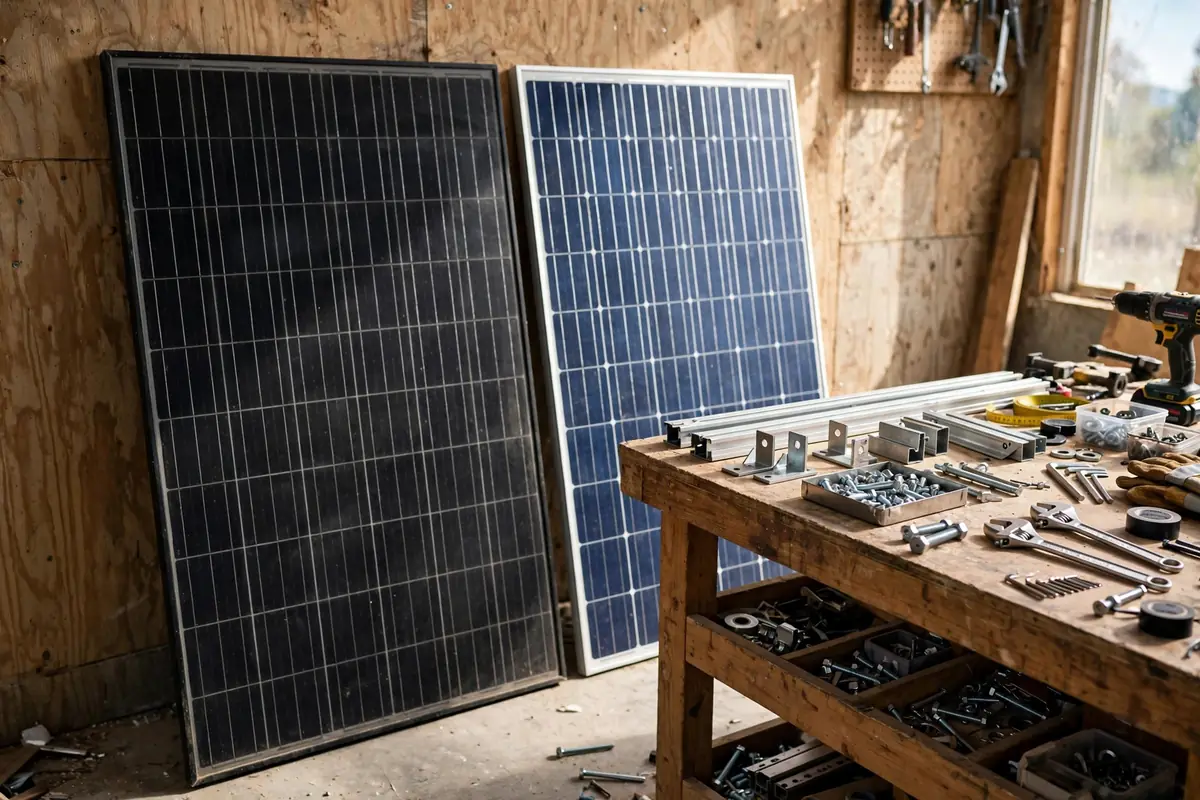
Buried in every 2026 panel datasheet is a single letter that predicts how the panel will age: N or P. N-type cells, built on TOPCon or heterojunction designs, degrade slower and handle heat better than the older P-type PERC cells that dominated the last decade. The premium is modest, usually a few cents per watt. For most buyers, it is worth paying.
- N-type cells (TOPCon, HJT) degrade around 0.4 percent per year or less; P-type PERC cells typically degrade 0.5 to 0.7 percent.
- The efficiency gap is real but modest: roughly 1 to 2 percentage points, which matters most on space-constrained roofs.
- N-type panels perform better in heat, losing less output on hot afternoons when you need power most.
- The price premium for N-type has shrunk to roughly $0.03 to $0.08 per watt, often under $500 on a full system.
- Check the datasheet: some budget “mono” panels are still P-type PERC. Know which you are buying.
What N-type and P-type actually mean
Solar cells are silicon wafers doped with tiny amounts of other elements to create an electric field. P-type wafers are doped with boron, giving them a positive charge character; N-type wafers are doped with phosphorus, giving them negative character. For years, the industry used P-type almost exclusively because boron doping was cheaper and the manufacturing was well understood.
The problem with boron is a degradation mechanism with an ugly name: light-induced degradation, or LID. When P-type cells first see sunlight, boron-oxygen complexes form in the silicon and permanently eat 1 to 3 percent of output within the first days of exposure. Manufacturers account for this in ratings, but it is power you never get back. N-type silicon doped with phosphorus does not form these complexes, so N-type panels skip LID almost entirely and start their 25-year life closer to their rated power.
TOPCon, HJT, and PERC in plain English
PERC (passivated emitter rear contact) was the P-type workhorse of the 2010s: a clever rear-surface treatment that squeezed extra efficiency from cheap P-type wafers. Most panels installed between 2016 and 2022 are PERC. It is mature, cheap, and thoroughly understood, which is why budget panels still use it.
TOPCon (tunnel oxide passivated contact) is the current N-type mainstream. It adds an ultra-thin oxide layer that lets electrons through while blocking the recombination that wastes energy. TOPCon took over new factory lines because manufacturers could adapt existing PERC equipment to make it, keeping costs down. Most mid-range and premium 2026 panels are TOPCon.
HJT (heterojunction) layers amorphous silicon on crystalline silicon, combining two cell technologies. It delivers the highest efficiencies and the best temperature performance of the three, and it degrades the slowest. HJT costs more to manufacture, so it appears mainly in premium lines like REC Alpha and some Maxeon products.
Head-to-head comparison
| Metric | P-type PERC | N-type TOPCon | N-type HJT |
|---|---|---|---|
| Typical efficiency | 19 to 21% | 21 to 23% | 22 to 24% |
| First-year degradation | 1.5 to 2% | About 1% | About 1% |
| Annual degradation after year 1 | 0.50 to 0.70% | 0.40% | 0.25 to 0.30% |
| Temperature coefficient | -0.34 to -0.38%/°C | -0.29 to -0.32%/°C | -0.24 to -0.26%/°C |
| Price premium | Baseline | $0.03 to $0.08/W | $0.10 to $0.20/W |
Two rows deserve attention. The degradation rows compound: after 25 years, a TOPCon panel typically retains about 89 percent of original output versus about 84 percent for PERC, a gap worth real money. The temperature coefficient row matters because panels lose output as they heat up; on a 150°F rooftop in Phoenix, the HJT panel’s gentler coefficient can mean 3 to 5 percent more afternoon power than PERC.
Note that the old mono versus poly debate is settled history; this N-versus-P comparison is its modern replacement, and unlike that one, both sides are still on the market.
The degradation difference, in dollars
Take an 8 kW system producing 12,000 kWh in year one at $0.20/kWh, or $2,400 of first-year value. With PERC degrading at 0.6 percent annually, lifetime 25-year production lands near 278,000 kWh. With TOPCon at 0.4 percent, it lands near 285,000 kWh. The 7,000 kWh gap is worth about $1,400 at today’s rates, more as rates rise. HJT at 0.3 percent stretches the gap further.
Against a TOPCon premium of roughly $300 to $600 on that system, the degradation advantage alone roughly pays for itself, before counting the efficiency and heat benefits. This is a modeled example, not a guarantee, but the direction is robust: slower degradation is worth paying a small premium for, because you collect the benefit every year for decades.
Warranty language reflects this. N-type panels commonly warranty 0.4 percent annual degradation with about 89 percent output at year 25. P-type PERC warranties typically allow 0.55 to 0.7 percent, landing near 84 to 87 percent at year 25. When running your 2026 solar economics, use the warrantied rate from your actual datasheet, not a marketing claim.
Heat performance matters more than you think
Solar panels are rated at 77°F cell temperature, but rooftop cells routinely hit 130 to 150°F on summer afternoons. Every degree above rating costs output according to the temperature coefficient. A PERC panel at -0.36%/°C on a 140°F day loses about 12 percent of rated power to heat alone. An HJT panel at -0.25%/°C loses about 8 percent.
This matters most exactly when it matters most: hot climates with afternoon air conditioning load and time-of-use rates that price evening power highest. In Phoenix, Las Vegas, or inland California, the heat advantage of N-type is not a footnote; it is a meaningful slice of annual production. In mild coastal climates, it barely registers. NREL’s PV performance modeling tools and Energy.gov’s homeowner resources both document how temperature derating affects real-world output by region.
Which should go on your roof
Choose N-type (TOPCon/HJT) when
- Roof space is limited and every watt counts
- You live in a hot climate with high AC load
- The premium is under $0.08/W (usually true in 2026)
- You plan to own the home long term
P-type PERC still makes sense when
- The quote is dramatically cheaper per watt
- Roof space is abundant and rates are low
- It is a rental or short-term ownership situation
- The installer warranties and supports it well
For most 2026 buyers, TOPCon is the sweet spot: near-premium degradation and heat performance at a small premium over PERC. HJT earns its bigger premium mainly on hot, space-constrained roofs. PERC remains a rational budget choice, just know you are buying it and price it accordingly.
A final note on warranty fine print, because this is where N-type’s advantage is contractually locked in. Read the performance warranty’s year-25 number, not just the annual percentage. Two panels can both claim “0.4 percent per year” while guaranteeing different year-25 floors, because one applies the rate linearly and the other includes a larger first-year step. The year-25 guaranteed output percentage is the comparable number across brands. Also check whether the product warranty (defects and failures) matches the performance warranty length; some budget N-type panels offer strong degradation numbers on a 15-year product warranty, which undermines the point of buying for longevity.
Whatever you choose, pair the decision with the right electronics: our microinverter versus optimizer guide and hybrid inverter explainer cover the other half of the equipment decision.
How do I know if a panel is N-type or P-type?
The datasheet lists cell technology. Look for TOPCon, HJT, or “N-type” in the specifications. If it says PERC without an N-type label, it is P-type.
Is TOPCon worth it over PERC?
Usually yes at 2026 premiums. The degradation and heat advantages typically repay a $0.03 to $0.08/W premium within the warranty period.
What is the difference between TOPCon and HJT?
Both are N-type. HJT offers slightly better efficiency, degradation, and heat performance at a higher price. TOPCon is the value pick; HJT is the premium pick.
Do N-type panels work better in winter?
Slightly. Their better low-light response helps on overcast days, but the difference is small compared to the heat and degradation advantages.
Will PERC panels disappear like poly did?
Probably, over time. Manufacturers are converting lines to TOPCon, and PERC is increasingly relegated to budget and utility-scale products. It remains widely available in 2026.
Ready to compare real solar prices?
Get free, no-pressure quotes from vetted local installers and see what solar costs for your roof.