
A decade ago, every solar buyer faced the same choice: pricier monocrystalline panels or cheaper polycrystalline ones. In 2026, that choice has quietly disappeared. Polycrystalline panels have nearly vanished from the US residential market, and every major manufacturer now builds mono. This guide explains what the old debate was about, why mono won so completely, and what actually matters in the panel choice you face today.
- Polycrystalline panels are effectively gone from US residential solar; virtually all 2026 installs use monocrystalline.
- Mono won on efficiency and cost: as mono manufacturing scaled, its price premium collapsed while its space advantage remained.
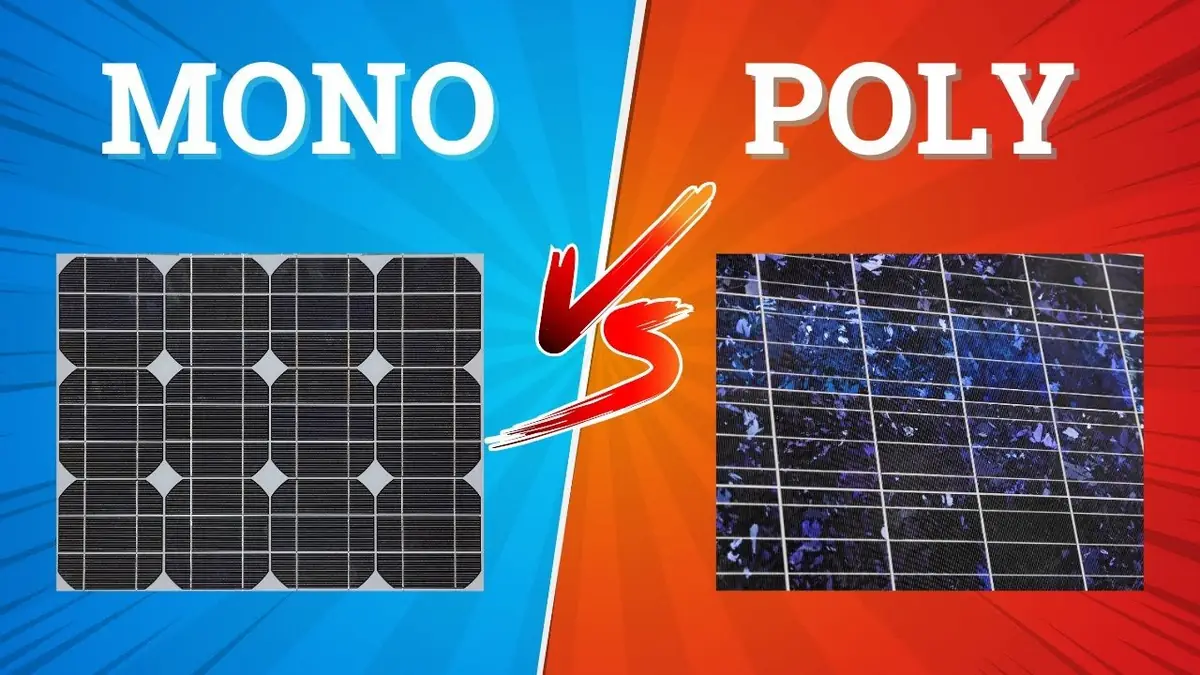
- The visible difference was the blue, speckled poly look versus mono’s uniform black, a cosmetic gap that also faded as all-black mono became standard.
- Today’s real panel debate is cell technology: N-type TOPCon and HJT versus older P-type PERC.
- If a quote still offers polycrystalline panels, treat it as old stock and negotiate accordingly, or walk away.
What mono and poly actually mean
Both panel types use silicon cells; the difference is how the silicon crystal is grown. Monocrystalline cells are cut from a single continuous crystal, giving electrons a clean path and yielding higher efficiency. Polycrystalline cells are cast from multiple silicon fragments melted together, creating grain boundaries that slightly impede electron flow and cap efficiency lower.
You could see the difference with your eyes. Poly panels had a distinctive blue, almost glittery appearance from the visible crystal fragments. Mono panels were darker and more uniform, and modern all-black mono panels are nearly indistinguishable from tinted glass at a distance. For homeowners who cared about curb appeal, mono’s looks were always part of the pitch.
The old debate: efficiency vs price
Through the mid-2010s, the trade-off was real and worth debating. Polycrystalline panels ran about 15 to 17 percent efficient versus 18 to 21 percent for mono, but cost roughly 10 to 20 percent less per watt. On a large roof with plenty of space, poly’s lower efficiency did not matter much: you simply installed a few more panels. Budget-focused buyers and large commercial projects chose poly by the megawatt.
Mono made sense when roof space was tight, because higher efficiency squeezed more watts from limited area, or when the buyer valued the sleeker appearance. Installers stocked both and quoted both. Comparison articles like this one were genuinely useful because the answer depended on the roof.
Why monocrystalline won completely
Three forces killed the debate. First, mono manufacturing scaled massively, driven by Chinese producers who pushed mono wafer costs down year after year. The price premium that justified poly’s existence shrank to a few cents per watt, then effectively to zero. When mono costs the same as poly, nobody chooses lower efficiency.
Second, the industry shifted to larger wafer formats and half-cut cells, innovations deployed on mono lines first. Poly never got these upgrades at scale because manufacturers had already stopped investing in poly production. The efficiency gap widened from 2 points to 4 or more, making poly uncompetitive even on price per watt.
Third, residential roofs kept getting relatively smaller compared to household electricity demand, especially as EVs and heat pumps added load. Space efficiency became more valuable just as mono became no more expensive. The market voted with purchase orders, and by the early 2020s, poly had essentially exited residential distribution in the US.
This history is worth knowing because today’s solar economics assume mono performance. Any production estimate or payback calculation built on poly-era numbers would understate what your roof can do.
Where you still see polycrystalline
| Where poly appears | Why | What to do |
|---|---|---|
| Old installer inventory | Clearing warehouse stock from years ago | Demand a steep discount or decline |
| Ultra-budget quotes | Rock-bottom price as the selling point | Compare lifetime output, not just price |
| DIY and used markets | Cheap secondhand panels for sheds and RVs | Fine for non-critical projects at the right price |
| Some developing markets | Price sensitivity outweighs efficiency | Not relevant to US residential buyers |
The important case is the first one. If a 2026 quote specifies polycrystalline panels for your home, you are looking at old stock, likely manufactured years ago and degrading slowly in a warehouse. Panels do not improve with age. A poly quote should be dramatically cheaper than mono alternatives to even merit consideration, and the product warranty clock may have already started. In practice, the right move is to ask for a mono requote.
Thin-film and other footnotes
Crystalline silicon is not the only solar technology, though it owns residential. Thin-film panels, most notably First Solar’s cadmium telluride (CdTe) modules, use a completely different semiconductor deposited in thin layers on glass. CdTe dominates American utility-scale solar thanks to low manufacturing cost and excellent hot-climate performance, and First Solar builds them in Ohio.
You will almost never see thin-film quoted for a home. The modules are large, lower-efficiency per square foot than mono, and designed for ground-mount racking, not rooftops. Their existence matters mainly as context: when someone claims a technology is “the best,” ask “best for what?” CdTe is best for desert solar farms. Mono silicon is best for your roof. Different winners for different games.
Other exotic technologies, perovskites, organic cells, concentrator systems, make headlines and have not reached residential roofs in any meaningful volume. If a quote ever offers something beyond crystalline silicon for your home, treat it as experimental until proven otherwise.
What matters now instead
The debate that replaced mono versus poly is cell technology within monocrystalline: N-type versus P-type cells. N-type technologies like TOPCon and heterojunction (HJT) deliver higher efficiency and slower degradation than the older P-type PERC cells that dominated the 2010s. This is the spec worth comparing on 2026 quotes, and unlike the old debate, both options are readily available.
Beyond cell type, the factors that actually differentiate panels today are degradation rate, temperature coefficient, warranty terms, and price per watt. The inverter and system design choices, covered in our microinverter versus optimizer guide and our hybrid inverter explainer, typically affect your lifetime savings more than the panel brand.
Practical buying advice
For a 2026 buyer, the mono-poly question has exactly one actionable takeaway: make sure your quote says monocrystalline, then move on to things that matter. Confirm the exact model number, check the degradation warranty (0.5 percent per year or better is standard for quality mono), and compare the price per watt against competing quotes. The Department of Energy’s homeowner’s guide to going solar offers a solid primer on these shopping basics, and the EIA’s electricity data browser helps you benchmark your local rates before sizing a system.
If you are replacing or expanding a very old poly system, note that modern mono panels are physically larger and electrically different, so mixing old and new panels on the same string is rarely clean. Most expansions either replace the old array or run the new panels on separate inverter inputs. Your installer should explain the plan before you commit.
The old debate served its purpose, but the industry settled it. Mono won, poly retired, and your attention is better spent on the installer, the inverter, and the quote math. The next time you see a mono-versus-poly comparison online, check its date: anything presenting it as a live decision is working from an outdated playbook.
Are polycrystalline panels still made?
In small volumes, mostly for price-sensitive markets outside the US. They have essentially disappeared from American residential distribution.
Is monocrystalline always better than polycrystalline?
For residential use, yes: higher efficiency at comparable cost, better appearance, and stronger warranties. There is no current residential scenario where poly wins.
How can I tell which type is on a quote?
The datasheet specifies cell type. If it says polycrystalline or “poly,” ask for a mono alternative. Reputable 2026 quotes list mono by default.
Do mono panels degrade slower than poly?
Modern mono panels typically warranty 0.5 percent annual degradation or better, versus 0.7 percent or worse on old poly. Cell technology (N-type vs P-type) matters more than the mono label itself.
Should I replace working poly panels with mono?
Almost never for economics alone. Working panels keep producing; replacement only makes sense during a roof replacement or a major system expansion.
Ready to compare real solar prices?
Get free, no-pressure quotes from vetted local installers and see what solar costs for your roof.