
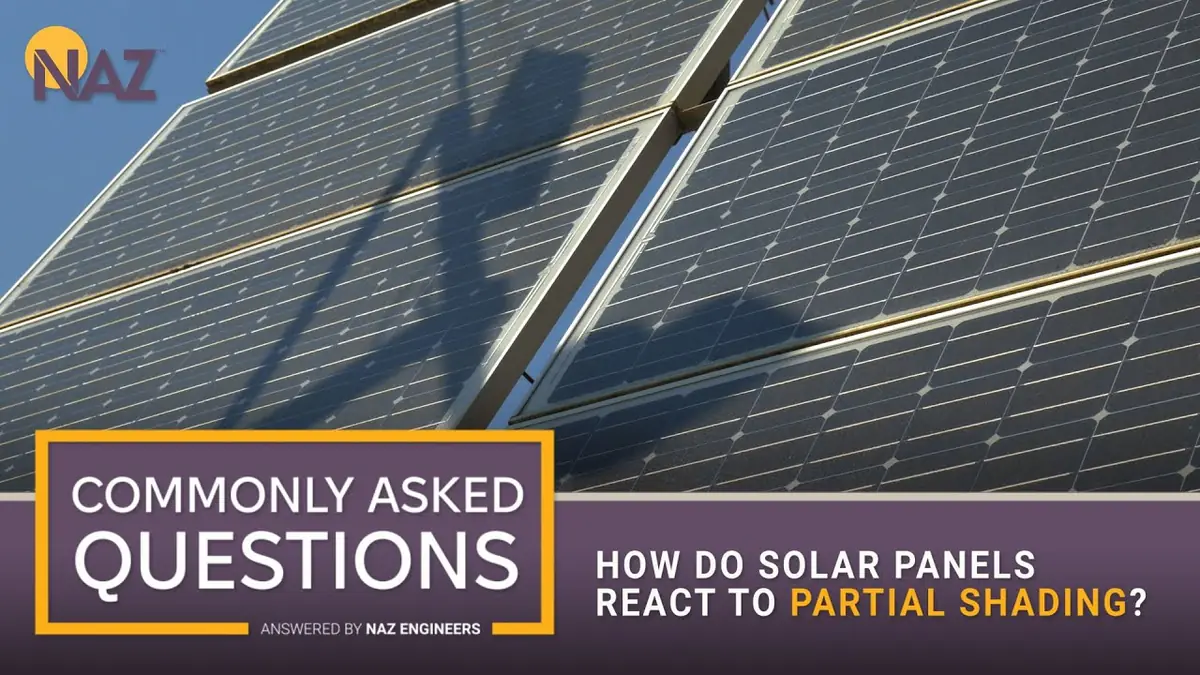
Shade is the most misunderstood enemy of rooftop solar: a shadow covering just a tenth of an array can cut output far more than a tenth. Here is how shade actually hurts production, how much is too much, and the design fixes that rescue a partially shaded roof.
- Shade losses are nonlinear: a small shadow can knock out a third of a panel, and one shaded panel can drag down a whole string.
- Keep annual shade losses under 10 to 15 percent. Beyond 20 percent, most systems stop making economic sense.
- Microinverters and DC optimizers isolate shade to the affected panel, recovering roughly 23 to 25 percent of shade-lost energy.
- The cheapest fix is avoidance: trim the tree, move the array, or leave the shaded roof section empty.
Why Shade Hurts More Than You Expect
Solar cells are wired in series, inside the panel and across the panels in a string. In a series circuit, current is limited by the weakest link. That is why a thin shadow from a vent pipe can cost more than a big soft shadow covering a whole panel evenly. Shade shape and position matter as much as size.
Panels defend themselves with bypass diodes, typically three per panel. When a group of cells goes dark, its diode routes current around that group so the rest of the panel keeps producing. The trade: the bypassed third of the panel contributes nothing. Shade one cell in each of the three diode groups and three tiny shadows can knock out nearly the whole panel.
A shaded cell forced to pass the string’s current can heat up dramatically, creating a hot spot that degrades the panel over time. Bypass diodes exist largely to prevent this damage, so chronic partial shade shortens panel life as well as cutting output. If your system is already installed and underperforming, our underperformance guide helps separate shade from other causes.
How Much Shade Is Actually Too Much
Installers quantify shade with Total Solar Resource Fraction (TSRF): the percentage of available sun your roof section receives after shade. A TSRF of 100 means no shade. Here is how to read the number:
Under 10 percent annual loss (TSRF 90+): excellent. Proceed with any equipment; shade is a rounding error in your payback math.
10 to 15 percent loss: acceptable for most projects. This is where module-level electronics earn their keep.
15 to 20 percent loss: marginal. Only workable with careful design, optimizers or microinverters, and honest production estimates. Get the shade analysis in writing.
Over 20 percent loss: usually too much for rooftop solar. The economics rarely survive once you divide cost by actual kilowatt-hours. Consider a ground-mounted array in a sunnier spot, or skip the project.
These are annual figures, and seasonality matters: a tree that barely shades the roof in June can cover half the array in December when the sun rides low. Good shade analysis models the full year. Ask your installer for a shade report from tools like Aurora or a Solmetric SunEye reading, not just an eyeball estimate. And the sales estimate is not a guarantee: proposals often assume best-case sun. NREL’s PVWatts calculator lets you sanity-check production estimates yourself.
| Shade scenario | Typical annual loss | Verdict |
|---|---|---|
| Light, brief morning shade from a distant tree | 3 to 8% | Fine with any equipment |
| Chimney or vent shadow crossing part of the array | 8 to 15% | Use microinverters or optimizers |
| Neighbor’s tree shading one roof section afternoons | 12 to 20% | Marginal; redesign or trim |
| Two-story neighbor directly south of a one-story home | 20 to 35% | Usually uneconomic on that roof face |
| Dormer-heavy roof with all-day moving shadows | 25%+ | Walk away or go ground-mount |
The Usual Shade Suspects
Most residential shade comes from a short list, and each has a characteristic fix.
Trees. The number one shade source. A mature oak grows; today’s shade report understates year ten. If the tree is yours, trimming is the cheapest solar upgrade you will ever buy. If it is the neighbor’s, you are negotiating, not engineering. Model the tree’s growth, not just its current canopy.
Chimneys, vents, and dormers. Roof features cast small, hard shadows that sweep across the array daily. These are the classic case for module-level electronics: the shadow is unavoidable, but its damage can be contained to the panels it touches.
Neighboring buildings. A two-story home directly south of your one-story roof is a structural problem, worst in winter. No electronics fix a building. Either use a different roof face or accept the loss honestly in the production estimate.
Soiling. Dirt, pollen, and bird droppings are shade by another name, and a heavily soiled module drags its string down like a shadow. See how often to clean solar panels for the maintenance side.
Snow. In northern states, snow is seasonal shade that can zero out production for days or weeks. Steeper tilts shed it faster, and winter output drops should be modeled with snow cover included.
Electronics That Fight Shade
When shade cannot be avoided, the inverter architecture decides how far the damage spreads.
String inverters wire 8 to 14 panels in series to one or two MPPT inputs. One shaded panel drags its whole string’s operating point down. The topology is the weakest against shade.
DC optimizers put a small converter on each panel, letting every panel run at its own maximum power point. In NREL-designed independent testing by PVEL, optimizers recovered about 24.8 percent of shade-lost energy versus a plain string inverter.
Microinverters convert DC to AC at each panel, so panels operate fully independently. The same PVEL testing showed microinverters recovering about 23.2 percent of shade-lost energy. On unshaded roofs the gap between architectures shrinks to a few percent, which is why electronics choice matters most exactly where shade is worst. Our Enphase vs SolarEdge guide compares the two architectures head to head.
One honest caveat: optimizers and microinverters consume a small amount of power themselves, around 1 to 2 percent. On a heavily shaded roof they are clearly worth it. On a perfectly clean roof, that overhead slightly favors the simpler string inverter.
Pros
- Microinverters and optimizers contain shade damage to the affected panels.
- Panel-level monitoring pinpoints underperforming panels.
- Multi-orientation roofs become viable.
Cons
- Module-level electronics add roughly $0.10 to $0.25 per watt.
- They cannot recover energy the shade physically blocks.
- More components on the roof means more failure points.
Designing Around Shade You Cannot Remove
Good designers treat shade as a layout problem first and an equipment problem second:
Leave the shaded section empty. If the west roof face takes afternoon tree shade, do not put panels there to hit a kilowatt target. A smaller unshaded array outperforms a larger half-shaded one per dollar.
Orient strings with shade in mind. With string inverters, keep panels that share shade timing on the same string and MPPT input, so the unshaded panels run free.
Use half-cut cell panels. Most modern panels split cells into two halves, making them inherently more shade-tolerant than older full-cell designs.
Consider the ground. A shaded roof with a sunny yard is a ground-mount project wearing a rooftop quote. Ground arrays cost more per watt but produce what they promise. Run both numbers before defaulting to the roof.
Model, do not guess. Insist on a written shade analysis with the production estimate. Cross-check with PVWatts using a derate that reflects the shade report. For background on how panels and inverters work together, the DOE Solar Energy Technologies Office is a solid starting point. And once installed, monitor per-panel production on your phone so a growing tree shows up in the data before it shows up in your bill.
When Shade Means Walking Away
Sometimes the right answer is no solar, and an honest installer will say so. Pause when the shade analysis shows over 20 percent annual loss on every usable roof face, when the only fix is a neighbor’s tree you cannot touch, or when payback needs perfect conditions to land inside 15 years.
Walking away is not failure. Community solar, a future ground-mount, or revisiting after tree work are legitimate next steps.
The bottom line: a little shade is an engineering problem; a lot of shade is a site problem. Know which one your roof has before you spend a dollar. If your roof is clear, our 7.6 kW cost guide shows what the most common system size runs in 2026.
How much shade is too much for solar panels?
As a rule of thumb, annual shade losses above 20 percent make most rooftop systems uneconomic. Under 10 percent is excellent, 10 to 15 percent is workable with the right electronics, and 15 to 20 percent is marginal. Get a written shade analysis rather than guessing.
Can a little shade really ruin solar panel output?
Yes, disproportionately. Cells are wired in series, so one shaded cell can throttle its whole string, and bypass diodes sacrifice a third of a panel to protect the rest. A small hard shadow often costs more than a large soft one.
Do microinverters fix shading problems?
They contain them. Microinverters and DC optimizers let each panel operate independently, so shade affects only the shaded panels. Independent testing showed them recovering roughly 23 to 25 percent of shade-lost energy versus plain string inverters.
Should I cut down a tree for solar panels?
Often yes if the tree is yours and shade loss exceeds 10 to 15 percent annually, since trimming is far cheaper than oversizing the array. Check local tree ordinances first, and model the tree’s future growth.
Does snow count as shading?
Effectively yes. Snow cover can zero out production for days, and it should be modeled as seasonal shade in northern states. Steeper panel tilts shed snow faster.
How do I check shade before buying solar?
Ask for a written shade analysis with the production estimate reflecting it. Cross-check the estimate with NREL’s PVWatts calculator, and be skeptical of proposals that assume zero shade on a roof with trees, chimneys, or dormers.
Ready to compare real solar prices?
Get free, no-pressure quotes from vetted local installers and see what solar costs for your roof.