
Your solar panels make the most electricity on long summer days, but heat quietly steals a share of that power. If your July production looks lower than expected, the cause is usually physics, not a broken system. This guide covers the four real reasons behind summer underperformance and how to tell normal losses from problems worth a service call.
- Heat is the biggest summer factor: most panels lose 0.3% to 0.5% of output per degree Celsius above 25°C, and rooftop cells often reach 65°C to 75°C.
- Inverter clipping caps midday peaks when panel wattage exceeds what the inverter can convert.
- Dust, pollen, and bird droppings typically cost 2% to 7% of summer production.
- A flat production curve on clear days usually means clipping or heat derating; a sudden drop on one section points to shade, soiling, or a failed component.
- Most summer losses are already baked into your installer’s production estimate, but a 20%+ shortfall versus last summer deserves investigation.
How Heat Cuts Panel Power
Solar panels love sunlight but hate heat, and that surprises most new owners. Every panel is rated under Standard Test Conditions at a cell temperature of 25°C (77°F), roughly a mild spring day. On a real summer roof, dark panels in direct sun run 30 to 40 degrees hotter than the air around them.
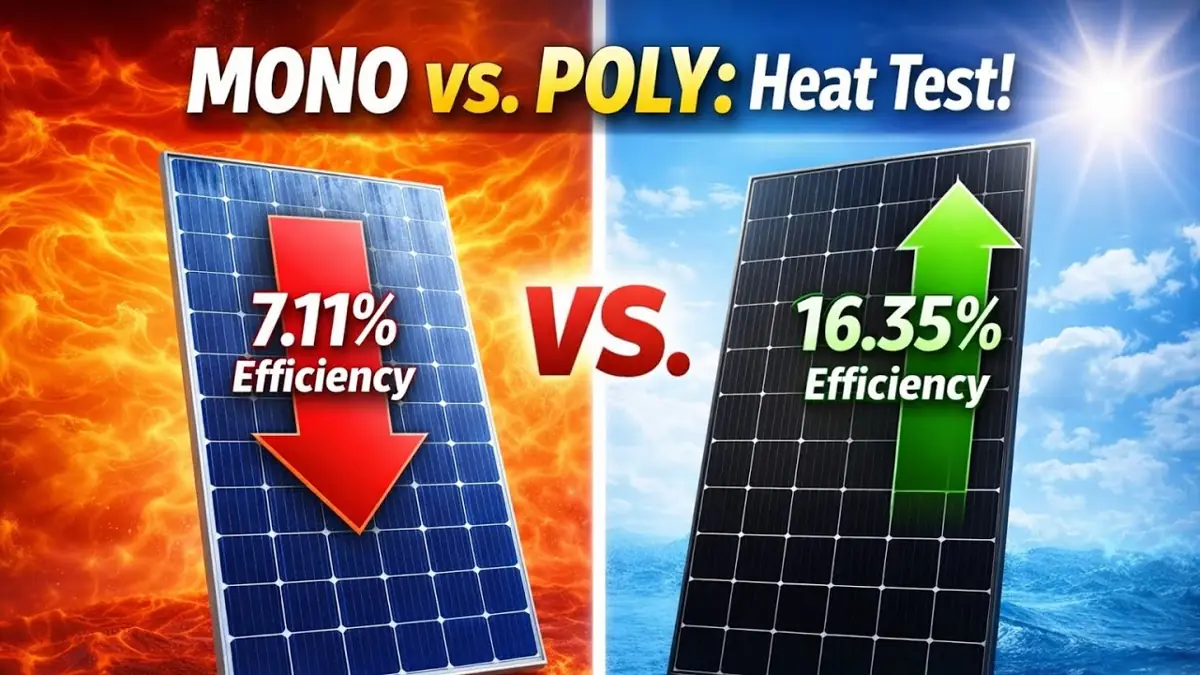
Heat reduces the voltage each cell produces, which drags total power down. The size of the penalty is printed on every panel datasheet as the temperature coefficient of Pmax, usually -0.34% to -0.45% per °C above 25°C. The Department of Energy’s homeowner guide to going solar explains how heat and other real-world factors shape actual production. A panel with a -0.40%/°C coefficient running at 70°C cell temperature is 45 degrees above its rating point, which works out to an 18% power reduction versus the nameplate wattage. That sounds alarming, but it is completely normal, and a well-built quote already accounts for it in its annual production estimate. Thermal wear also compounds slowly over the years, as our guide to solar panel degradation rates explains.
Clipping and the Midday Plateau
Open your monitoring app on a clear summer day and look at the shape of the production curve. A healthy system traces a smooth bell curve that peaks around solar noon. A system that is clipping shows a flat-topped curve, like a hill with its peak sliced off, because the inverter cannot convert all the DC power the panels are producing.
Clipping is usually intentional. Installers routinely pair panels with slightly undersized inverters (a DC-to-AC ratio around 1.2 to 1.3) because panels rarely hit their lab-rated wattage, and the extra capacity boosts morning and evening production. With Enphase microinverters, each unit has a hard ceiling, so clipping shows up as every panel flatlining at the same value.
A little clipping, typically 1% to 3% of annual energy, is a sign of a well-optimized design rather than a defect. Heavy clipping that lops hours off your daily peak suggests the DC-to-AC ratio was pushed too far, though the financial impact is usually modest. To check your own curve, see our walkthrough on how to monitor your solar system from your phone, or compare notes with EnergySage’s solar guide.
Soiling, Shade, and Sun Angle
Summer brings the year’s worst soiling in much of the country: pollen in spring, dust through dry spells, and bird droppings in exactly the wrong spot. The National Renewable Energy Laboratory has found that soiling typically costs residential systems 2% to 7% of annual production, with higher losses in desert regions or near farms and construction sites.
Partial shade behaves differently than uniform dirt. A single shaded cell can drag down a whole string of panels on older string-inverter systems, while microinverters and optimizers isolate the loss to the affected panels. Summer is also when shade patterns change: trees leaf out fully, and a branch that cleared your array in April may shade two panels by July.
Sun angle plays a smaller role than people assume. Summer geometry is actually favorable in the northern hemisphere, since panels produce most when the sun is high. What hurts is haze and wildfire smoke, which scatter sunlight and trim production on smoky days. Our honest take on how often you should clean solar panels explains when a rinse is worth your time and when rain does the job for free.
Inverter Derating in High Heat
Inverters are computers that happen to handle kilowatts, and they protect themselves from heat the same way your laptop does: by slowing down. When a string inverter’s internal temperature climbs past its design threshold, usually on afternoons above 100°F with the unit in direct sun, it derates output to stay within safe limits.
Microinverters handle heat better because they sit under the panels with airflow around them and each one handles only a few hundred watts, but they are not immune. Good installers mount string inverters on shaded walls or add simple sun shields, which is worth asking about if your inverter bakes in afternoon sun.
Derating is distinct from a fault. A derating inverter keeps producing at a reduced level and recovers as it cools, while a faulted inverter shows an error code or goes offline entirely. If yours is showing a warning, our guide on what to do when your inverter shows an error code walks through the common codes and the safe first steps before you call for service.
Normal Losses vs Real Problems
Here is how to read your own system like a technician. Compare this summer’s production to last summer’s for the same month, not to the system’s nameplate rating and not to spring. A healthy system should track within about 5% of the prior year after accounting for weather. Panel-level monitoring makes this easier: uniform underperformance points to heat, clipping, or soiling, while one or two lagging panels point to shade, debris, or a failed microinverter or optimizer.
| Symptom | Likely cause | Typical loss | What to check |
|---|---|---|---|
| All panels down 10-20% on hot afternoons | Temperature losses | 10% to 20% at peak heat | Normal; compare to last July |
| Flat-topped curve at midday | Inverter clipping | 1% to 3% annually | Normal if brief |
| Gradual decline over dry weeks | Soiling buildup | 2% to 7% | Rinse if visibly dirty |
| One panel far below the rest | Shade, debris, or failed electronics | Varies | Check for new shade; call installer |
| Sudden drop to zero | Tripped breaker or fault | 100% until fixed | Check breakers and display now |
The number that matters most is your annual total versus the production estimate in your original proposal, which already models local weather, roof orientation, shade, temperature, and soiling. If first-year production lands within 10% of the estimate, your system is doing its job. Persistent shortfalls beyond that, especially ones that grow month over month, justify a warranty call. Slow decline is priced into how long solar panels last, with warranties typically guaranteeing 85% to 92% of rated power after 25 years.
What You Can Actually Do About It
Start with the free checks. Look at the array from the ground for visible dirt, debris, or new shade, and review a month of monitoring data for patterns. A garden-hose rinse on a cool morning can recover a few percent if panels are visibly dusty, but skip the pressure washer and harsh soaps, which can damage seals and void warranties.
For the inverter, make sure nothing blocks its ventilation and that it is not baking in reflected afternoon sun. A simple shade cover can reduce derating for a string inverter on a sun-blasted wall. Do not open the unit or change settings yourself; the high-voltage DC side of a string system is dangerous and warranty terms usually require certified service.
Know when to stop troubleshooting and call your installer: sudden production loss, repeated error codes, a burning smell near the inverter, or visible damage to panels or wiring. Most workmanship warranties run 10 to 25 years, so a legitimate fault should cost you nothing to fix. Document everything with dated screenshots from your monitoring app before you call.
Related Maintenance Guides
If this guide helped, these deep dives cover the rest of keeping your system healthy:
- Why Your Solar Output Drops in Winter (and How Much Is Normal)
- How Often Should You Clean Solar Panels? The Honest Answer
- Do Solar Panels Need Maintenance, or Are They Truly Set and Forget?
- What to Do When Your Inverter Shows an Error Code
- How to Monitor Your Solar System From Your Phone
- Do Solar Panels Cause Roof Leaks? What 10 Years of Data Show
- Can Hail Destroy Solar Panels? Impact Ratings Explained
Why is my solar output lower in summer than spring?
Spring often beats summer because panels run cooler while days are already long. A panel at 45°C in April will outproduce the same panel at 70°C in July even with slightly fewer daylight hours.
Do solar panels work better in hot or cold weather?
Cold, sunny weather. Panels are rated at 25°C cell temperature and lose roughly 0.3% to 0.5% of output per degree above that. A bright 40°F day can produce more instantaneous power than a 105°F day.
Is inverter clipping bad for my system?
No. Mild clipping is a deliberate design choice that trades a small midday loss for better morning and evening production, and it does not damage the inverter.
How much production loss in summer is normal?
Expect peak-hour output 10% to 20% below the panel nameplate rating on hot afternoons from temperature effects alone, plus a few percent from soiling. Compare monthly totals to the same month last year; within 5% year over year is healthy.
Should I hose down my panels on hot days to cool them?
It is not worth it. Spraying cold water on hot panels risks thermal shock to the glass and seals, and any cooling effect fades within minutes.
Ready to compare real solar prices?
Get free, no-pressure quotes from vetted local installers for your roof.